Imagine you are a 16-year-old high school junior, walking into your honors chemistry class. You’ve never heard the words “copper chloride” before, but after a 20-minute lesson delivered by your teacher, the expectation is that you will don goggles and gloves and place the corrosive substance in a flame.
Earth Space Science Teacher Mrs. Virginia Hall understands how anxiety-inducing a situation like that can be. “I know if I were a student, I would have felt so intimidated jumping straight into a real lab—handling chemicals can be scary and dangerous,” she said.
“For me, starting with virtual experiments makes a lot of sense.”
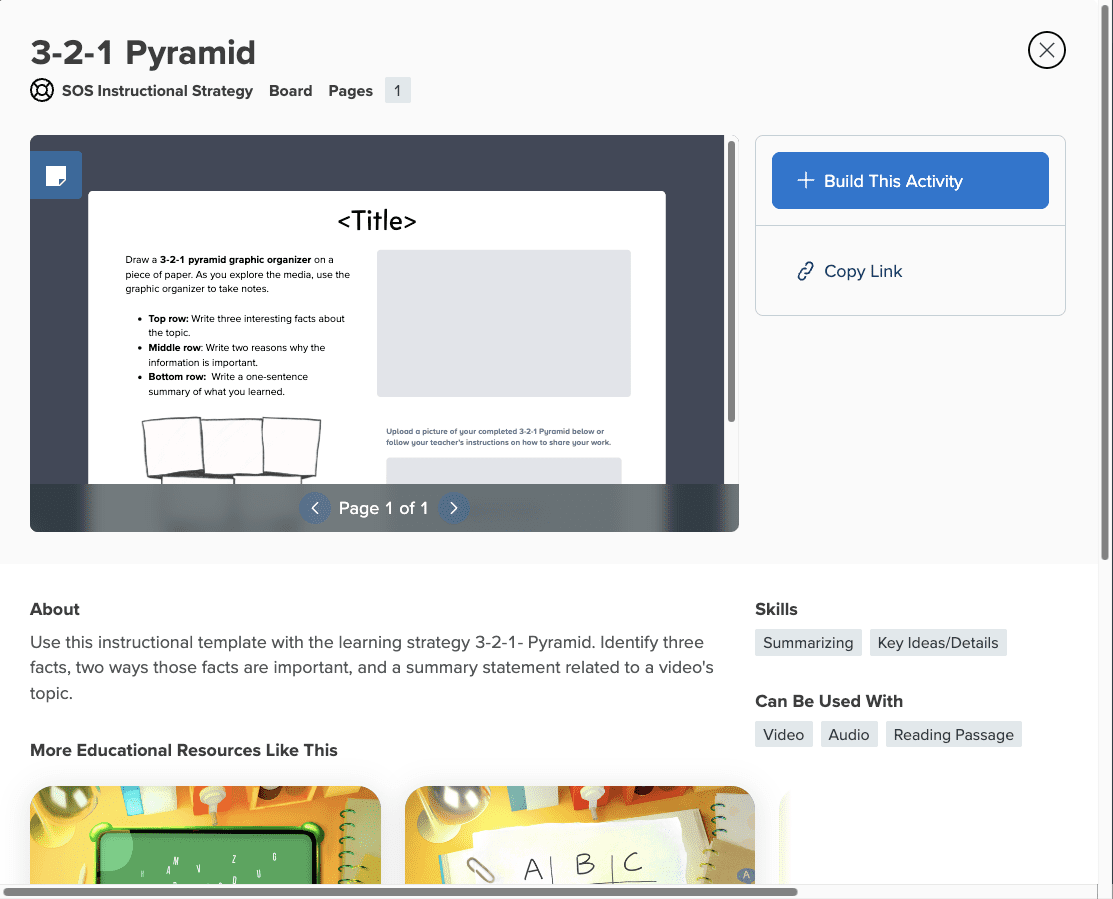
So, after teaching a lesson about the fundamentals of chemical reactions, Mrs. Hall uses Discovery Education Experience’s Studio Boards to provide students with an additional opportunity to reinforce what they’ve learned. Studio Boards are digital, collaborative project spaces where teachers and students create and share interactive content that aligns with curriculum. That could be text, video, games, images, quizzes, and more—all creatively organized for maximum engagement.
Interactive, but Safe
For the fundamentals lesson, Hall uses Experience’s Mixing Room Studio Board as an extension activity to reinforce learning. The interactive tool allows students to virtually combine chemicals and observe reactions, helping them visualize exothermic and endothermic processes in a controlled, risk-free environment.
“To build on this, I incorporate the Chem Lab Escape game on Roblox (which is part of the Mixing Room Studio Board), where students navigate a virtual chemistry lab and solve puzzles that require applying their knowledge of reactions, such as mixing specific chemicals to unlock areas or deactivate systems,” said Hall.
Supporting Instruction, Driving Engagement
Miranda Mosley, an Instructional Technology Resource Teacher, oversees the utilization of Discovery Education Experience across 92 schools and knows that the Studio Boards are a powerful tool. So, she started working with teachers to create social studies and science Boards for K-12, aligned with curriculum guides.
In addition, Mosley says, Studio Boards are a great tool for newer teachers, who may still be getting acquainted with standards, as well as substitute teachers who can pop in and keep the class moving ahead.
Boosting Engagement Through Friendly Competition
The next step was letting teachers know about the creation of the aligned Boards, so Mosley decided to run a district-wide contest to increase usage. The class with the highest usage earned a party (complete with chicken tenders and ice cream sundaes!), and the elementary, middle, and high school teachers with the highest usage earned a trophy.
The district had long had strong elementary usage, but the contest especially boosted middle and high school usage for the 24-25 school year, with 19% and 159% increases, respectively. The contest was so successful that Mosley is evolving it for this school year, with teachers creating their own Studio Boards.
Saving Time, Building Confidence
Once teachers have created the Boards, they can use them for years to come. “As time passes, they can add to them – they’ll find something that someone else has already created and can just pop it in there,” said Mosley. “You don’t need to recreate the wheel every year, and that’s a huge timesaver for teachers.”
Hall seconds the timesaver element—she appreciates how the Studio Boards and virtual experiments help her save time and allow her students to try different scenarios multiple times.
“They can see results instantly and play with variables to really understand the concept. For me, the best part is that once they do a similar real lab experiment, it feels so much less intimidating because they already have an idea of what to expect and what to look for. It makes the real lab feel more meaningful—and more fun!”