Key takeaways
-
Social studies is made up of five unique disciplines: history, geography, economics, and civics that work together to explain how the world functions.
-
Social studies helps students develop critical thinking skills.
-
Social studies connects the past to the present and prepares students to be informed, active citizens.
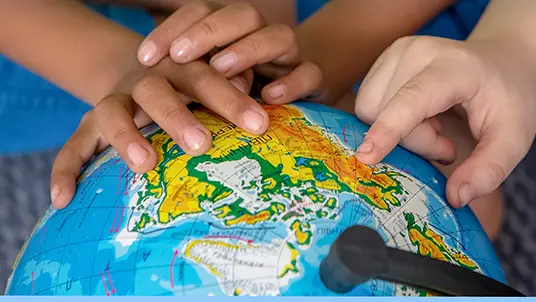
If one thinks back to their earliest Social studies lessons, it brings back fond memories of learning about the Nina, the Pinta, and the Santa Maria, or visions of what the midnight ride of Paul Revere must have looked or sounded like. Social studies is both a ticket into the past and a time machine into the future. This core subject is taught from Kindergarten through 12th grade and helps students better understand the world and its people. From studying maps to learning about famous people, social studies brings together the concepts of history, geography, economics, and government. Students will compare and contrast history vs social studies and see how each plays a role in understanding the world. Learning about how the past and the present are connected helps students see how their actions can shape the future. This is important when thinking about history vs social studies, because history is just one part of the larger subject.
What is social studies?
Social studies is the study of people, places, and societies. Students learn more about the role individuals play in their communities and how these communities function within the world. It should not be viewed as a single subject but as content that brings together several disciplines: history, geography, economics, and civics. History examines the past, geography explores places and the environment, economics is about resources and finances, and civics explores government and citizenship.
Together, these five disciplines help students see and understand connections within the world around them. From seeing how one’s geography influences their local economy and how they earn a living, to which laws and leaders are involved in the civic process, to how things are similar to and different from the past. Social studies is so much more than just maps or history lessons. It is disciplines that interact and influence one another. When students explore the vast world of social studies, they begin to see patterns, make predictions, and more.
Social studies is best taught through inquiry that promotes real-world connections, extending far beyond memorization. There are so many activities to help students actively explore the social studies curriculum. From role-playing as a government leader to presenting monologues as a civil rights activist, social studies is never meant to be about mere memorization. Including activities that promote critical thinking and authentic analysis is what helps today’s students become tomorrow’s leaders. And those leaders have the potential to learn from history’s pitfalls, hopefully preventing similar mistakes from recurring.
To fully understand where people settled and how governments formed, a working knowledge of geography is essential. The same is true for seeing how the economy or financial system works hand in hand with the government. Knowledge of these vast skills creates meaningful connections that help students engage with the real world. By understanding these ideas and connecting them, students begin to see how social studies is a combination of five disciplines that work together.
Why is social studies important?
Social studies helps students become informed and responsible citizens. When students analyze letters, photos, and speeches, they begin to apply critical thinking skills to understand why events happened. These sources are often preserved as historical artifacts, offering glimpses into the past. By comparing viewpoints, students see how perspectives can differ and shape historical accounts. By using evidence to support ideas in classroom discussions, writing exercises, and projects, students are applying these social studies skills to real-world situations. In this way, social studies shows that knowledge is power.
From discussing current events and forming opinions based on facts to examining how laws and policies affect communities, social studies prepares students to be informed citizens who do not take things at face value. Instead, they are becoming active thinkers who can connect past events to present-day issues. These skills are important for success in school, careers, and everyday life.
Social studies is so much more than something students learn in school. It is used daily in the real world. For example, when people vote, they draw on their knowledge of civics and government to exercise their rights and privileges. Furthermore, when they make financial decisions, such as budgeting or saving money, they apply economic concepts.
Understanding current events and what is happening in the world is more meaningful through social studies. Evaluating sources, recognizing bias, and comparing different viewpoints are all part of helping students form opinions and use decision-making skills in and out of the classroom.
Social studies also helps people understand others. When people explore and learn about different cultures, histories, and perspectives, they become more aware of the world around them. By learning these valuable social studies lessons, everyone can be more respectful of the differences in our world.
Explore K-12 Social Studies Resources
See how Discovery Education can support social studies.
What is the difference between history and social studies?
When thinking about history vs social studies, it helps to understand how the two are connected. Think about the five disciplines that were previously mentioned: history, geography, economics, and civics. Think of social studies as a giant umbrella, with history as one of the parts that fit under it. History explains what happened, and social studies help understand why it happened. Social studies is also a means to see how different systems are connected and how they relate to the world today.
What does social studies teach in K-12?
Social studies grows with students. As students progress from kindergarten through primary, intermediate, middle school, and high school, social studies grows with them. They go from understanding their own community to thinking about the entire world and their place in it.
During the early primary years, students begin learning about the world. Elementary school-aged students begin developing their knowledge of social studies by exploring the world closest to them. They explore what it means to be part of a community and how people within their community work together. By reading maps, recognizing different cultures, and more, they begin to understand that the past helps shape the present. In kindergarten through third grade and in fifth grade, social studies answers questions such as: What is social studies? Who am I in my community? How do people live and work together? Students may learn through stories, maps, and hands-on activities, helping them connect their learning to their own lives.
Around sixth grade, social studies shifts from focusing on one’s community and immediate surroundings to studying different regions, cultures, and time periods. These studies help students make connections across the world. They begin to understand how governments function and how economic choices affect everyday life. Students start asking questions, including: how are people around the world similar to and different from me, and how do decisions shape societies? Through analysis of cause-and-effect relationships and closer comparison of societies, students begin to understand how decisions shape communities and influence the world around them.
Then, in high school, students begin analyzing the real world. They will dive deeper into complex ideas, from analyzing historical events to evaluating government systems to reviewing how economic systems operate. Students are busy connecting the different social studies disciplines to current events to form opinions supported by evidence. At the secondary level, social studies challenges students to consider how the past influences today’s world and how their choices shape the future. Some of the most enduring skills students master are evaluating evidence, forming arguments, and defending their ideas using multiple sources; these essential skills prepare students for college, careers, and informed citizenship.
All in all, social studies is not just about learning facts. It is about preparing students to become thoughtful, informed, and active members of society. With an understanding of the past, an analysis of the present, and critical thoughts about the future, students are acquiring the tools needed to navigate an ever-changing world. In the end, social studies empowers students not only to understand the world but also to actively shape it.
Discovery Education offers inquiry-based, standards-aligned social studies programs to build deep conceptual understanding, critical thinking, and literacy. Their programs include Social Studies Essentials for ready-to-teach K–5 lessons that support consistent Tier 1 routines and include content aligned to the C3 Framework, Social Studies Techbook for grades 6–8 project-based learning that includes primary source analysis, and Discovery Education Experience for supplemental K–12 instructional resources that support high-quality Tier 1 social studies teaching and career readiness.
Find Your Grade
Whether you’re planning your year, mapping out units, or looking for grade-specific social studies resources, we’ve got you covered.
Select your grade level below to access targeted social studies guides, core objectives, and teaching tools.