Social studies helps students understand history, civics, communities, and the world around them, but fitting it into a busy school day can be challenging. Social Studies Essentials makes it more manageable with curated, standards-aligned resources grounded in the C3 Framework and designed to build literacy, inquiry, and critical-thinking skills. This sample lesson on the Civil War shows the program’s breadth and depth, with teacher-led instruction, rich content, and opportunities for students to discuss, question, and deepen their understanding.
The causes of the Civil War are complex, and fifth graders benefit from a structured way to work through them. This lesson starts with a question students can relate to, why a state might want its own rules, and builds toward a close reading of a primary source from 1861.
This Civil War lesson plan helps students answer one question: What were the causes of the Civil War? Below you will find every step of the lesson, including timing, teacher instructions, discussion questions, sample responses, differentiation ideas, and vocabulary.
Civil War Lesson Plan Overview
- Grade: 5
- Total time: 80 minutes (can be split into two 40-minute sessions; see the timing modification below)
- Lesson question: What were the causes of the Civil War?
- Learning target: I will explain causes of the Civil War.
Lesson at a glance
- Introduction
- Think About It: instructional hook
- Prepare to Learn: learning target and graphic organizer
- Build Knowledge
- Read and Think
- Video and video transcript
- Analyze an Artifact
- Meet the Document: partner activity
- Discuss It: teacher-led discussion
- Make Sense of It: read aloud to clarify thinking
- Closing
- Make Connections: check for understanding
- Way to Go: learning target revisited
How to Prepare for the Lesson
Preparation
- Access the educator support document to support lesson planning.
- Assess students after the lesson.
Graphic organizer
- Print the graphic organizer and make a copy for each student.
- Ask students to record the Learning Target.
- Prompt students to take notes and generate questions throughout their learning.
Artifact activity
- Print the PDF Activity Secession of Mississippi from the Federal Union (excerpted): Whittle It Down.
- Make an additional copy of page 3 for each student.
- Provide a piece of large chart paper, divided into three sections (fold or draw a line) for each group.
- Gather a marker for each student to use in small groups.
Differentiation
- Use Copy & Edit to modify this lesson to further meet your students’ needs.
- Use the Immersive Reader functionality to have words read aloud, enlarge the text, and create line-by-line focus.
Access this and many other social studies lesson plans with a free trial.
Civil War Lesson Plan: Step by Step
Think About It: States’ Rights vs. National Laws (5 minutes)
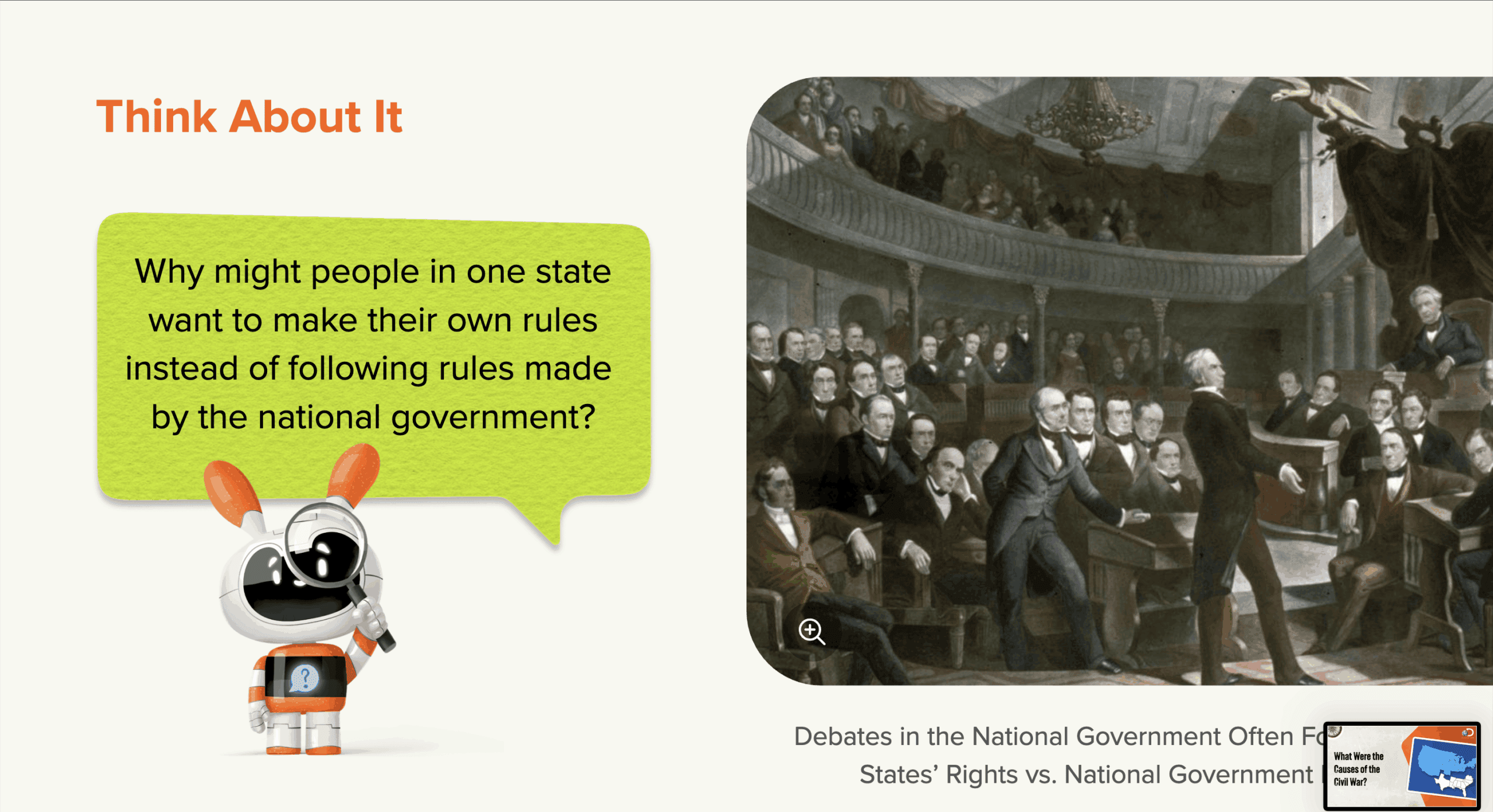
On the slide: Think About It. Why might people in one state want to make their own rules instead of following rules made by the national government? The slide image is captioned: Debates in the National Government Often Focused on States’ Rights vs. National Government Laws.
Driving question: What were the causes of the Civil War?
Suggestions for use
- Use the driving question and the guiding questions to prompt student discussion about why people in one state might want to make their own rules instead of following rules made by the national government.
- Provide space for students to discuss and ask questions that come to mind with a partner.
- Prompt students to continue thinking about the causes of the Civil War during this lesson.
Guiding questions to support discussion
- What are some reasons a state might feel a national law doesn’t fit its people or economy? Sample response: A state that depends on farming might say a national law for factories or trade hurts their economy. They may feel the law was made by people who don’t understand their daily lives.
- How could different beliefs about rights make a state prefer its own rules? Sample response: If many people in a state believe strongly in a right, they might want to keep rules that protect that right even if the national government disagrees.
- What problems could happen if one state follows different rules than the rest of the country? Sample response: It could cause confusion (people not knowing which laws to follow), unfair advantages (one state benefiting over others), or conflict between state and national leaders. In extreme cases, it could lead to states refusing to obey national laws or trying to leave the country.
Prepare to Learn (3 minutes)
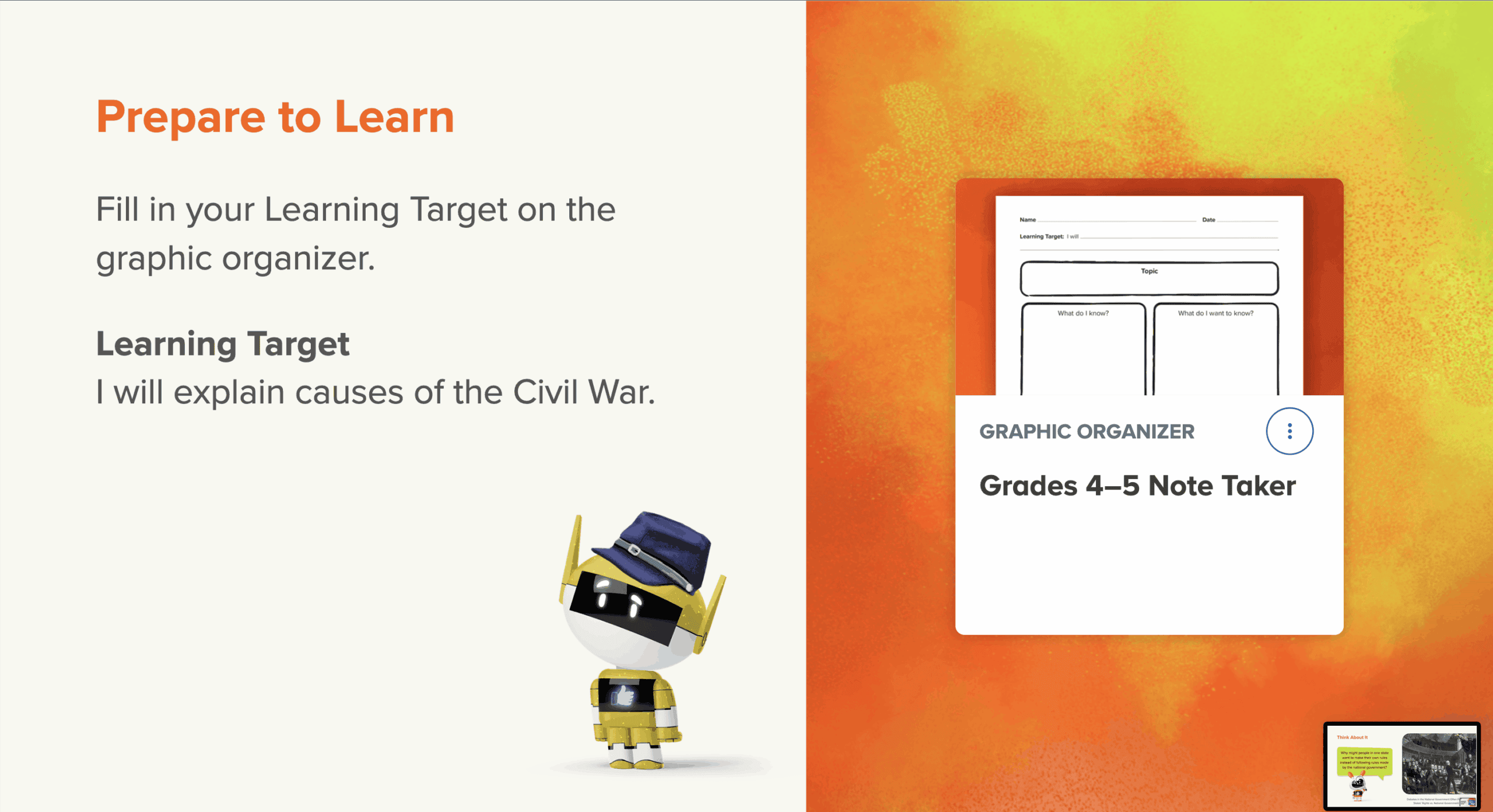
On the slide: Prepare to Learn. Fill in your Learning Target on the graphic organizer. The slide shows the learning target and a Grades 4 to 5 Note Taker graphic organizer.
Learning target: I will explain causes of the Civil War.
Suggestions for use
Provide students with support to capture their thinking throughout their learning.
- Print the graphic organizer.
- Ask students to record the Learning Target.
- Prompt students to take notes and generate questions throughout their learning.
Read and Think (10 minutes)
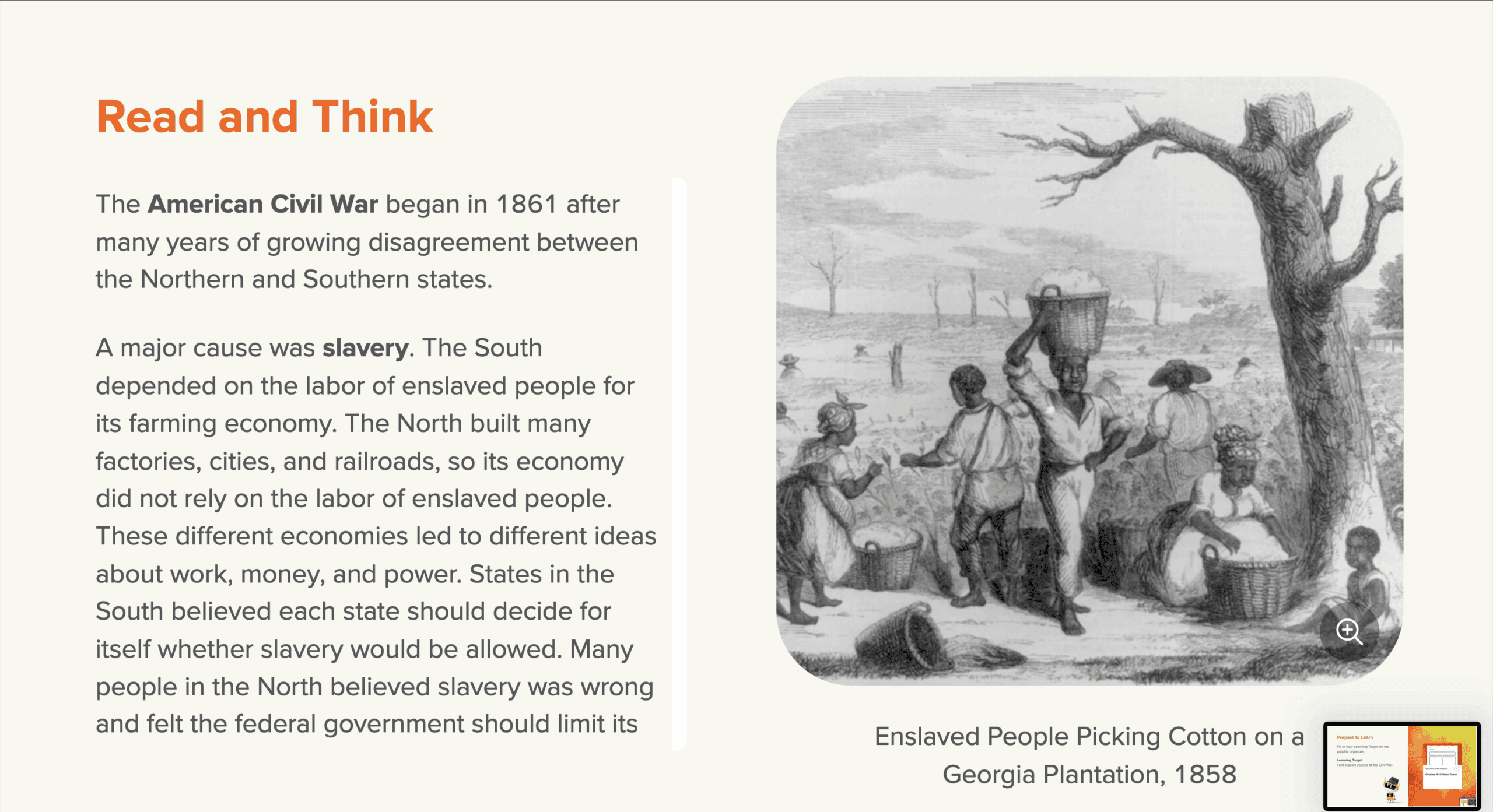
On the slide: Read and Think. The American Civil War began in 1861 after many years of growing disagreement between the Northern and Southern states. A major cause was slavery. The South depended on the labor of enslaved people for its farming economy. The North built many factories, cities, and railroads, so its economy did not rely on the labor of enslaved people. These different economies led to different ideas about work, money, and power. States in the South believed each state should decide for itself whether slavery would be allowed. Many people in the North believed slavery was wrong and felt the federal government should limit its… (the text on the slide is cut off in the lesson notes PDF). The slide image is captioned: Enslaved People Picking Cotton on a Georgia Plantation, 1858.
Suggestions for use
- Ask students to write down key words and facts from the description.
- Have students discuss the topic with one another and share their thoughts.
- Prompt students to jot down any questions or curiosities that they have.
- Facilitate a class discussion to share observations, knowledge, and questions, connecting them to the broader historical context.
Vocabulary
Teach the definitions of the bolded keywords to ensure student comprehension of key vocabulary in this lesson:
- American Civil War: a war fought over slavery between the Northern and Southern United States from 1861 to 1865
- slavery: a system where people are treated like property and forced to work
- states’ rights: the idea that individual states should have the power to make their own decisions and laws, instead of the national government making all the rules
- secede: to withdraw from a group or a political union
Differentiation
- Pair students for support in reading and recording key words and facts.
- Provide sentence starters or a word bank to help students express their understanding, connections, and questions.
- Challenge advanced students to connect their notes and questions to research or further exploration.
Watch to Learn (10 minutes)
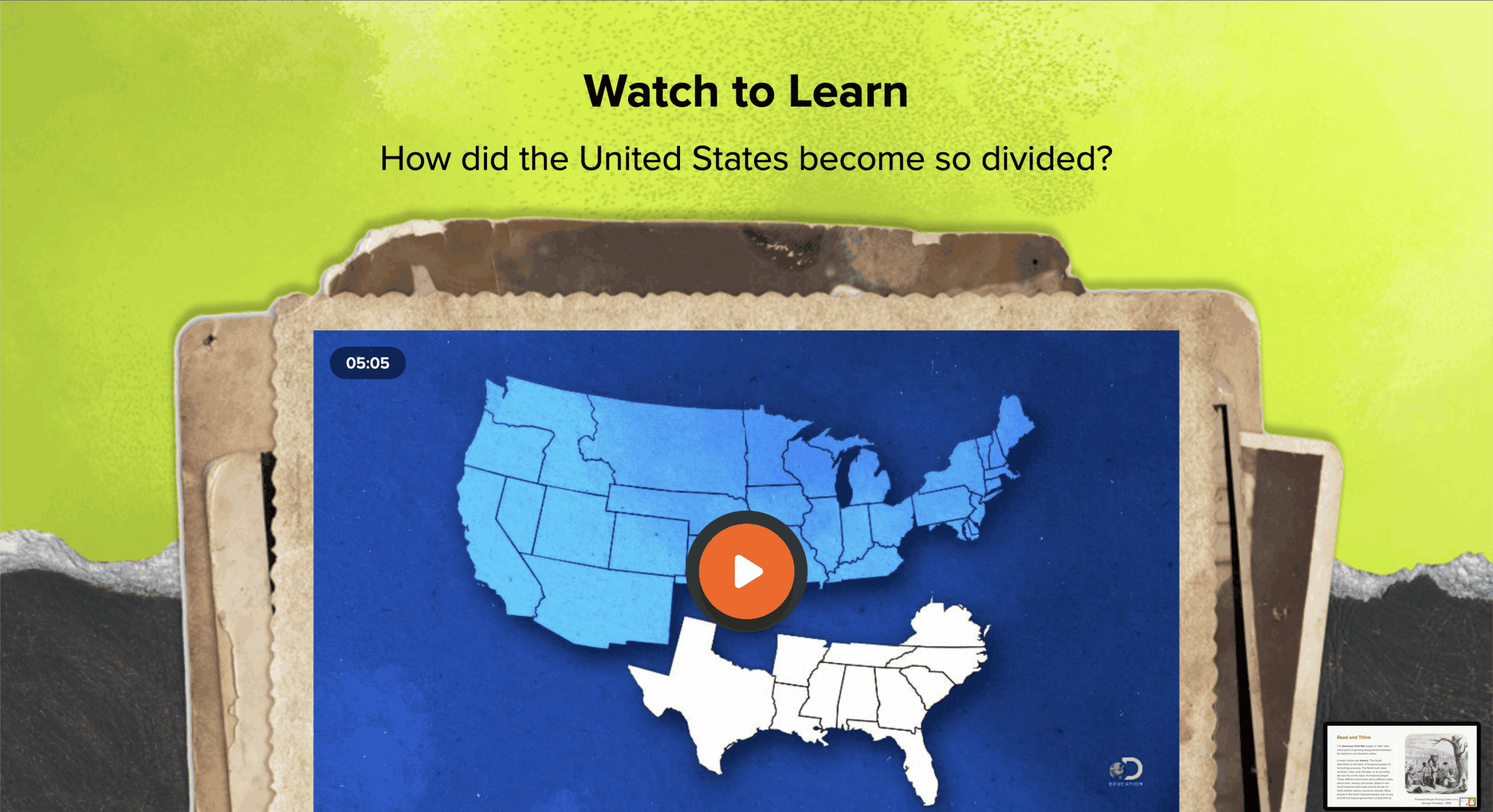
On the slide: Watch to Learn. How did the United States become so divided? The video runs 5 minutes and 5 seconds.
Suggestions for use
- Direct students to look for evidence in the video that answers the question prompt: How did the United States become so divided?
- How did the United States become so divided? Sample response: The United States became divided because people disagreed over the continuation of slavery in the United States. Some believed that it was each individual state’s right to decide whether it allowed slavery or not, while others believed slavery was wrong and should be abolished.
- Play the media for the class, and remind students to take notes on their graphic organizer.
- Utilize the Fullscreen option to show the video fullscreen.
- Allow students to discuss their answers to the question prompt with a partner.
- Direct students to generate additional questions that they would like to learn about on their graphic organizer.
- Revisit the lesson’s driving question: What were the causes of the Civil War?
Differentiation
- Print the video transcript PDF and ask students to annotate the text to support a close reading strategy.
Reflect On It: Fighting Unfair Laws (5 minutes)
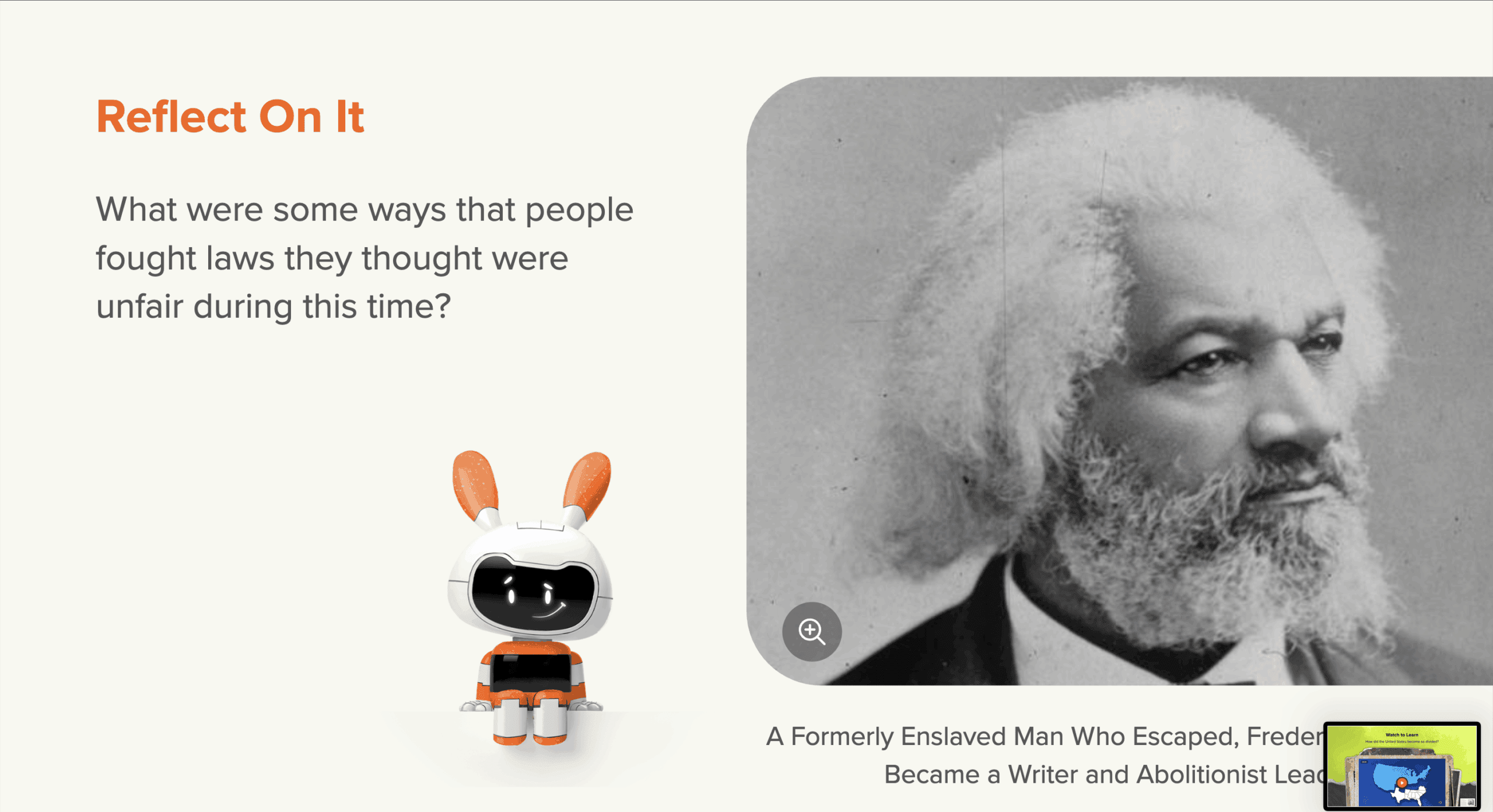
On the slide: Reflect On It. What were some ways that people fought laws they thought were unfair during this time? The slide image is captioned: A Formerly Enslaved Man Who Escaped, Frederick Douglass Became a Writer and Abolitionist Leader.
Suggestions for use
- Read the question to help students reflect on ways people fought laws they thought were unfair:
- What were some ways that people fought laws they thought were unfair during this time? Sample response: Writers and speakers, like Frederick Douglass, shared stories and essays to show how wrong slavery was. Abolitionists met, formed clubs, and held meetings to teach others and plan actions. The Underground Railroad was a secret network of people and safe places that helped enslaved people reach freedom. People held rallies, gave speeches, and published newspapers to persuade others. A few individuals, such as John Brown, tried to fight by force.
- Provide time for students to share their responses with the class or a partner.
- Summarize student responses about ways people fought laws they thought were unfair.
Analyze an Artifact: Introduce the Activity (1 minute)
On the slide: Analyze an Artifact. Now that you’ve started thinking about the causes of the Civil War, let’s take a look at a document focused on this time in history.
These four slides provide a classroom activity to enable students to analyze a historic artifact and communicate their findings in order to better understand the causes of the Civil War.
Complete the artifact activity preparation steps listed earlier in this post before you begin.
Meet the Document: Whittle It Down (10 to 15 minutes)
Format: Small groups
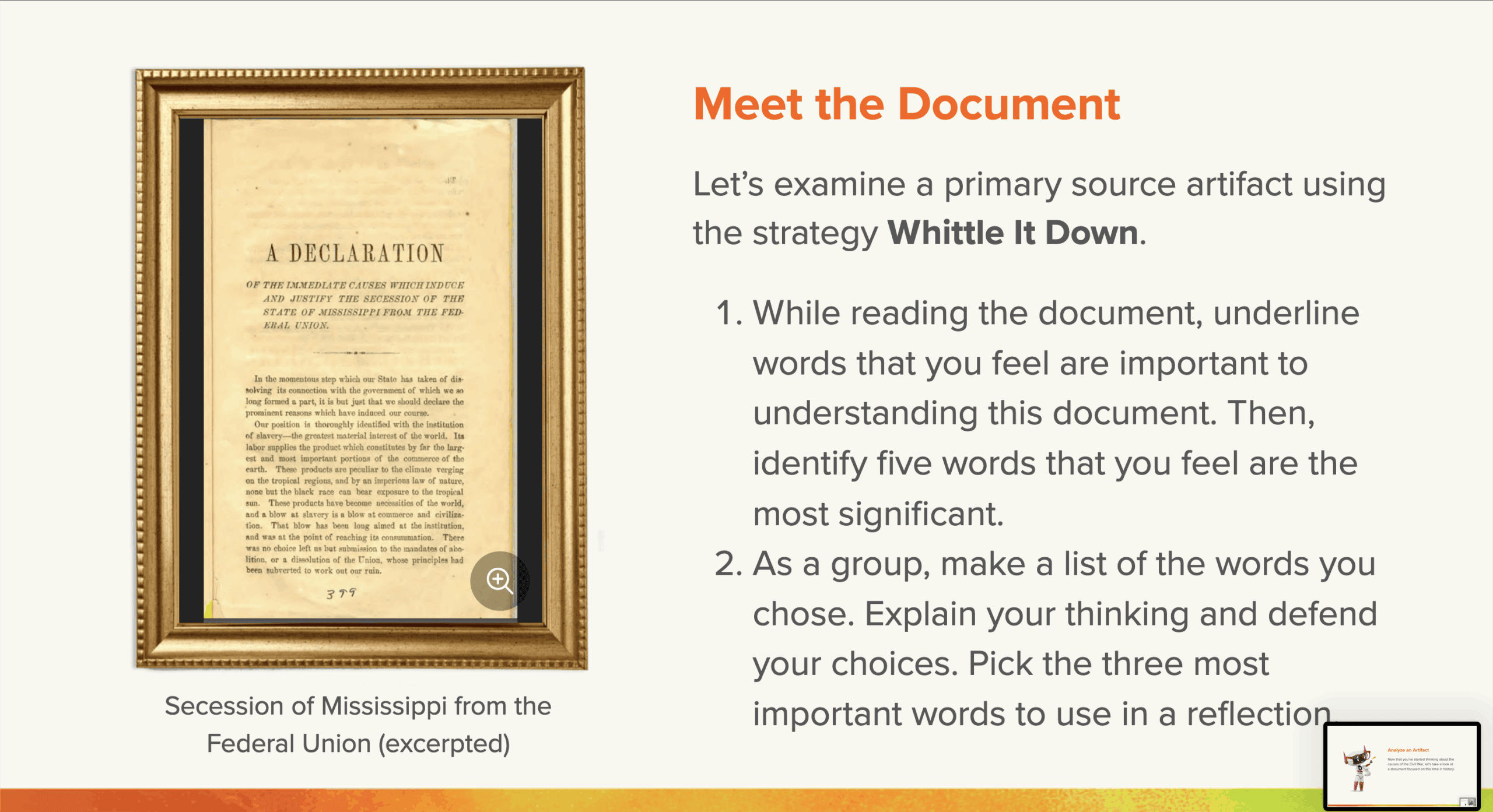
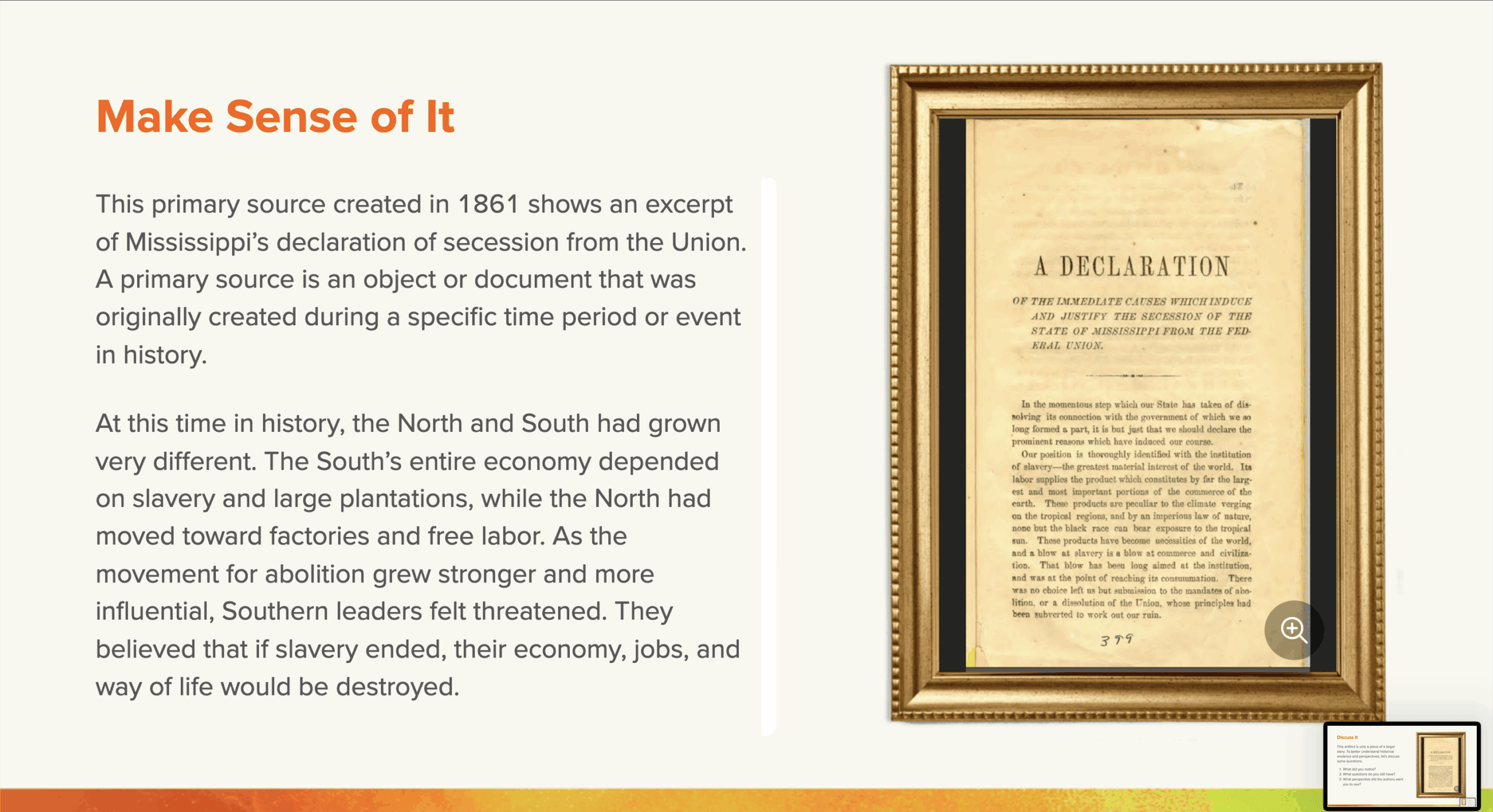
On the slide: Meet the Document. Let’s examine a primary source artifact using the strategy Whittle It Down. 1. While reading the document, underline words that you feel are important to understanding this document. Then, identify five words that you feel are the most significant. 2. As a group, make a list of the words you chose. Explain your thinking and defend your choices. Pick the three most important words to use in a reflection. The slide shows an excerpt of Secession of Mississippi from the Federal Union.
Activity instructions
- Present this slide to remind students of the Whittle It Down strategy instructions.
- Assign students into groups with up to four students.
- Provide a different color marker and a copy of page 3 of the PDF Activity Secession of Mississippi from the Federal Union (excerpted): Whittle It Down.
- Examine the artifact with the students and encourage them to consider the big idea. Have students click on the image to read the document excerpt.
- Set a timer for three minutes, asking each student to reread the excerpt, underlining words they think are important.
- Set a timer for two minutes, directing each student to list five of the most important words they underlined from their excerpt in the top section of the chart paper.
- Prompt students to read the words each group member listed on the chart paper.
- Set a timer for two minutes, asking students to share their words, listen to their group members, and circle words on their list that are in common.
- Set a timer for two minutes for groups to agree upon and write the three most important words in the middle of their chart paper.
- Set a timer for five minutes, asking groups to use those three words to create a main idea sentence at the bottom of their chart paper.
- Bring the class back together and lead the Discuss It slide discussion.
Differentiation
- If students are experiencing difficulty identifying important words, suggest the following terms and allow students to look up the definitions: prominent, induced, mandates, dissolution, subverted.
Teacher tip: Student-friendly language. Many statewide and nationwide documents are written in vocabulary that may be too complex for students. Here is a quick summary of the document in student-friendly language:
Southern leaders decided to leave the United States because they believed the national government was going to end slavery, which was the foundation of their economy and way of life. They felt they had no choice but to break away to protect themselves.
Suggestions for use
- Select the Zoom icon for students to view the image larger.
- This activity was inspired by the SOS Instructional Strategy Whittle It Down. To learn more about this strategy, check out the following resources: the Whittle It Down PDF activity, the Whittle It Down full video, and the Whittle It Down for Students video.
Discuss It (10 minutes)
Format: Teacher-led classroom discussion
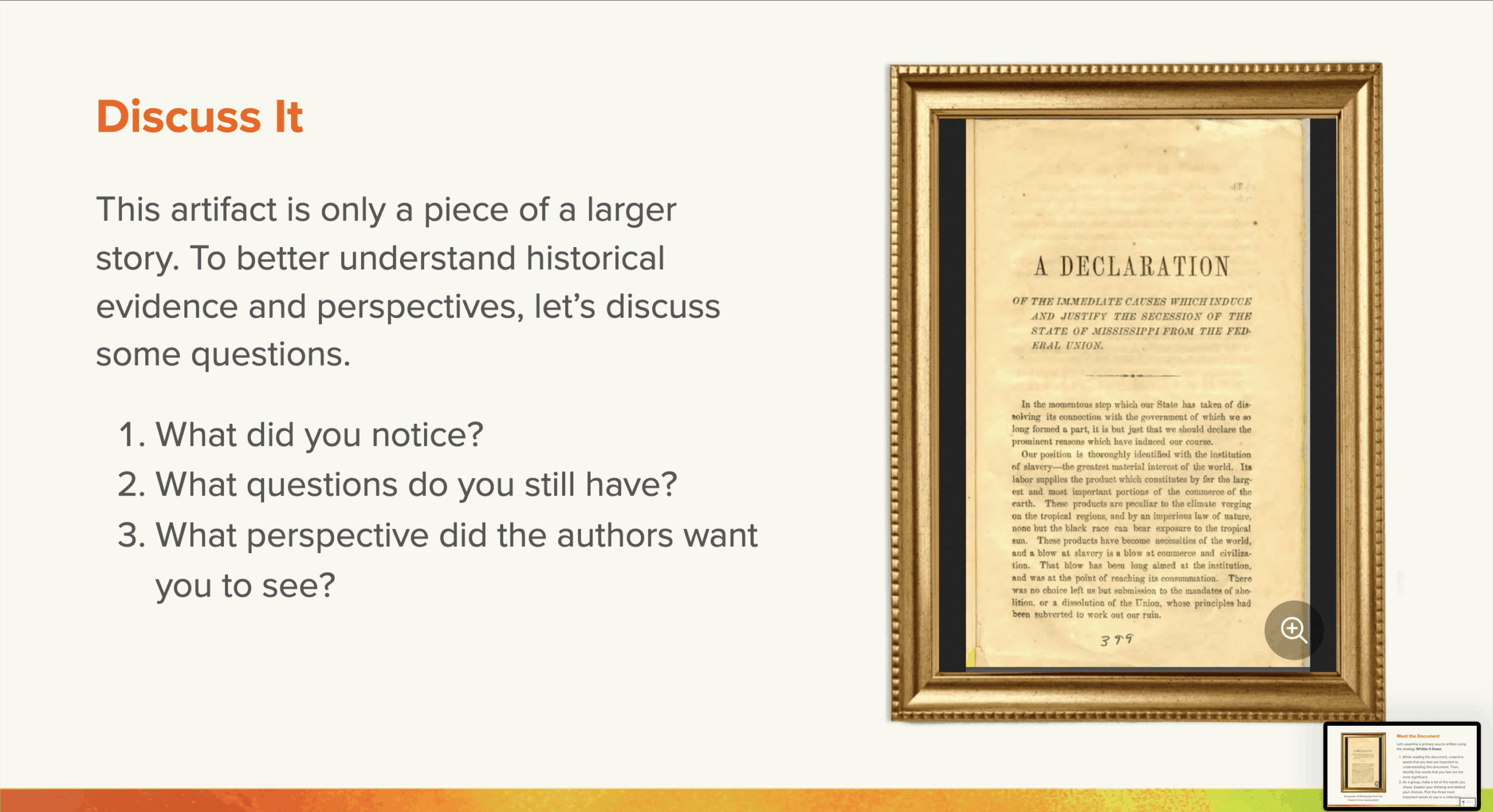
On the slide: Discuss It. This artifact is only a piece of a larger story. To better understand historical evidence and perspectives, let’s discuss some questions. 1. What did you notice? 2. What questions do you still have? 3. What perspective did the authors want you to see?
Activity instructions
- Ask students to return to their seats, if they have not already.
- Clarify any questions about specific comments from students’ responses.
- Read each question prompt on the slide and provide students with the opportunity to share their thinking.
- Focus on enabling student discourse, without approving or disapproving their answers.
- Clarify students’ thinking on the next slide, Make Sense of It.
Teacher tip: Understanding perspectives in artifacts. Each individual has a unique viewpoint that is influenced by their background, beliefs, and experiences. When people create something, they bring their own distinctive perspective to their work.
Make Sense of It (11 minutes)
Format: Teacher-led read aloud
On the slide: Make Sense of It. This primary source created in 1861 shows an excerpt of Mississippi’s declaration of secession from the Union. A primary source is an object or document that was originally created during a specific time period or event in history. At this time in history, the North and South had grown very different. The South’s entire economy depended on slavery and large plantations, while the North had moved toward factories and free labor. As the movement for abolition grew stronger and more influential, Southern leaders felt threatened. They believed that if slavery ended, their economy, jobs, and way of life would be destroyed.
Activity instructions
- Read the text aloud using the scroll bar.
- Pause to address specific misconceptions that students shared during the class discussion.
- Direct students to update any misconceptions captured on their graphic organizers. For example, students might need to cross out incorrect ideas or add important information that is missing.
- Learn more about the source using the About the Document section.
Differentiation
- Use the Immersive Reader functionality to have words read aloud, enlarge the text, and create line-by-line focus.
Make Connections (10 minutes)
Format: Closing and check for understanding
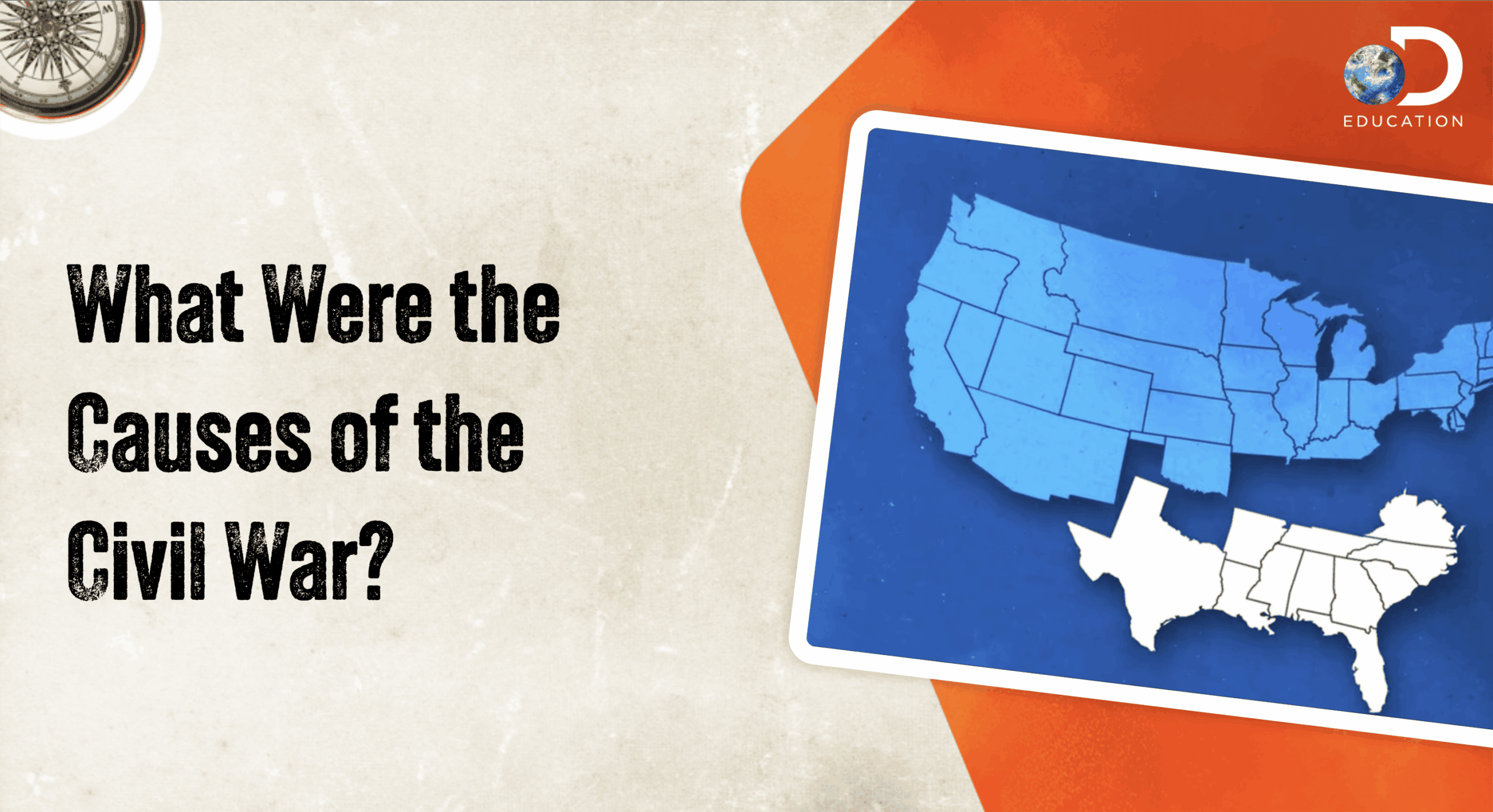
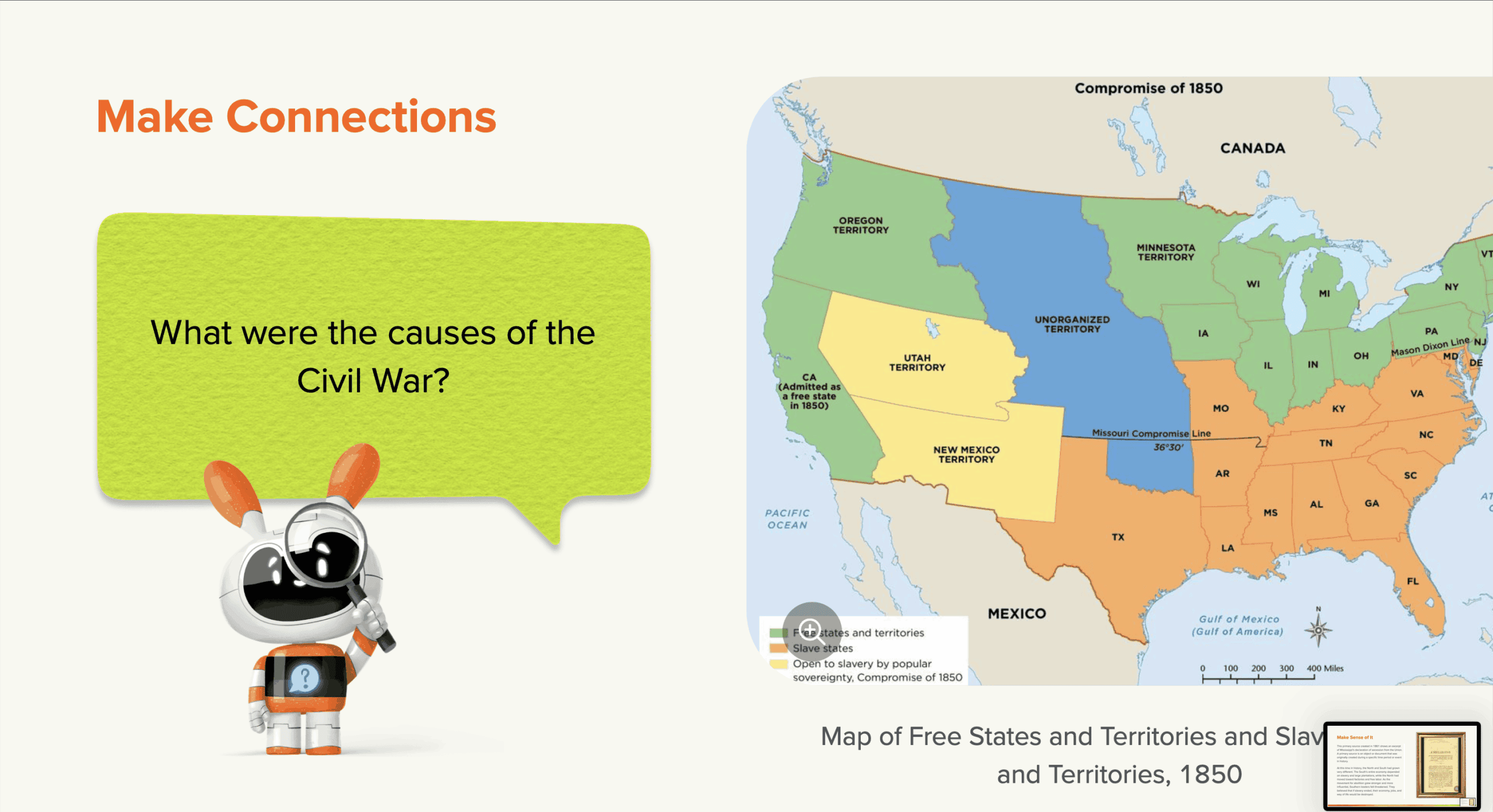
On the slide: Make Connections. What were the causes of the Civil War? The slide image is captioned: Map of Free States and Territories and Slave States and Territories, 1850.
Suggestions for use
- See if students can synthesize the information provided on the previous slide to answer the question prompt: What were the causes of the Civil War?
- Sample response: The Civil War happened because people and states strongly disagreed about slavery, who should make important laws (states or the national government), and how the country’s economy and new territories should be organized. These disagreements grew until war began.
- Sample response: Many people believed that slavery was wrong and fought against the continuation of the institution in the United States.
- Make connections to the concept of the causes of the Civil War and students’ lives today. For example, the debate over states’ rights and the laws of the national government still happens today.
Way to Go: Revisit the Learning Target
On the slide: Way to Go! You’ve learned about the causes of the Civil War.
This closing slide revisits the learning target. The lesson notes do not include a teacher note or a time for this slide.
Key Vocabulary for the Civil War Lesson
- American Civil War: a war fought over slavery between the Northern and Southern United States from 1861 to 1865
- slavery: a system where people are treated like property and forced to work
- states’ rights: the idea that individual states should have the power to make their own decisions and laws, instead of the national government making all the rules
- secede: to withdraw from a group or a political union
Timing Modification: Split the Lesson Into Two Sessions
This lesson could be split into two 40-minute sessions:
Part 1: Introduce the lesson using slides 1 to 3. Then, use slides 4 to 5 to build knowledge by reading text and watching a video related to causes of the Civil War. Use slide 6 to engage students with a reflection question.
Part 2: Use slides 7 to 10 to analyze an artifact that connects to causes of the Civil War. Use slide 11 to check students’ understanding of the lesson question.
Helping Students Explain Why the War Began
Students leave this Civil War lesson plan able to explain that the Civil War grew out of long-running disagreements about slavery, about who should make important laws, and about how the country’s economy and new territories should be organized. Discussing a question about states’ rights, reading and watching to learn, and analyzing a primary source with a small group gives students several ways to build and defend that explanation.
Access this and many other social studies lesson plans with a free trial.