Key takeaways
-
Strong literacy grows from knowledge-rich learning, not ELA time alone.
-
Social studies gives students the context and vocabulary that make reading comprehension possible.
-
By analyzing sources and building arguments, students strengthen both literacy and critical thinking.

Educators are under enormous pressure to meet reading proficiency goals; in fact the most recent National Assessment of Educational Progress (NAEP) scores show that over half of fourth graders are reading below grade level. 1 And while the instinct may be to invest more time into ELA instruction (more reading passages, more grammar practice, more vocabulary drills), dedicated ELA time doesn’t have to be the only strategy, in fact, research suggests it shouldn’t be.
A study2 recently found that social studies was the only subject with a clear, statistically significant effect on reading improvement, and extra ELA time alone showed no measurable gains. This study is backed by decades of supporting research linking content-rich instruction to stronger literacy outcomes.
The connection between content knowledge and literacy is deep, well-documented, and too important to ignore. Here’s why social studies deserves a central place in any serious effort to develop strong readers and writers.
Background Knowledge Is the Foundation of Reading Comprehension
Reading isn’t just decoding words on a page. It’s constructing meaning, and that process depends heavily on what a reader already knows. When a student encounters a passage about the American Revolution, their ability to understand it hinges on whether they know what a colony was, why taxation without representation mattered, and what life looked like in eighteenth-century America.
Reading comprehension is not a transferable, all-purpose skill. It’s deeply tied to domain knowledge. A student who is a “good reader” on a passage about baseball may struggle with a passage about the water cycle, not because their reading ability changed, but because their background knowledge shifted.
Social studies help students build the background knowledge that makes later reading more accessible. It introduces students to areas like history, civics, and economics, and deepens knowledge to make future reading easier, across every subject.
Social Studies Introduces Rich, Domain-Specific Vocabulary
Words like democracy, migration, economy, continent, and civilization aren’t just words for social studies alone. They appear across many disciplines, from science texts and novels to news articles and speeches. But social studies is often where students first encounter these words in meaningful, memorable contexts.
According to the National Reading Panel,3 seeing vocabulary in authentic context, rather than isolated vocabulary drills, produces robust vocabulary learning. When a student learns the word “explorer” they could memorize the textbook definition (a person who travels to unfamiliar places to learn about them), or they could learn about it while following Lewis and Clark’s journey across uncharted territory, sketching maps, encountering grizzlies, and relying on Sacagawea for survival. Suddenly, “explorer” isn’t just an abstract vocabulary word, it’s adventure and discovery.
Over time, students learn more new words, and the more words students know, the more they can read, and the more they read, the more words they learn.
How does Discovery Education’s Social Studies Essentials support vocabulary development?
Programs like Social Studies Essentials put this research into practice. Literacy support runs throughout the entire program. Students encounter vocabulary through student-friendly definitions and strong visuals, then use reflection questions to connect learning beyond the classroom. Collaborative conversations build grade-level speaking, listening, and comprehension skills as students make their way through lessons.
The program’s “Explore” model takes this work a step further by giving students bite-sized chunks of content paired with quick activities that reinforce learning, exactly the type of meaningful exposure that makes vocabulary words stick.

Students Learn to Read and Evaluate Different Text Types
ELA classes tend to center on literature and informational passages, but Social Studies takes reading a step further. In a single lesson, students might analyze a letter from a soldier, interpret a political cartoon, read a treaty, examine a map, compare newspaper editorials from different eras, and study data from a census report.
Each of these text types demands different reading strategies. A political cartoon requires visual literacy and an understanding of satire. A personal letter requires attention to historical context and perspective. A data table requires the ability to identify patterns and draw conclusions from numbers. That variety helps students become more flexible readers who can adjust their approach depending on the text in front of them.
How does Discovery Education’s Social Studies Essentials enhance text engagement?
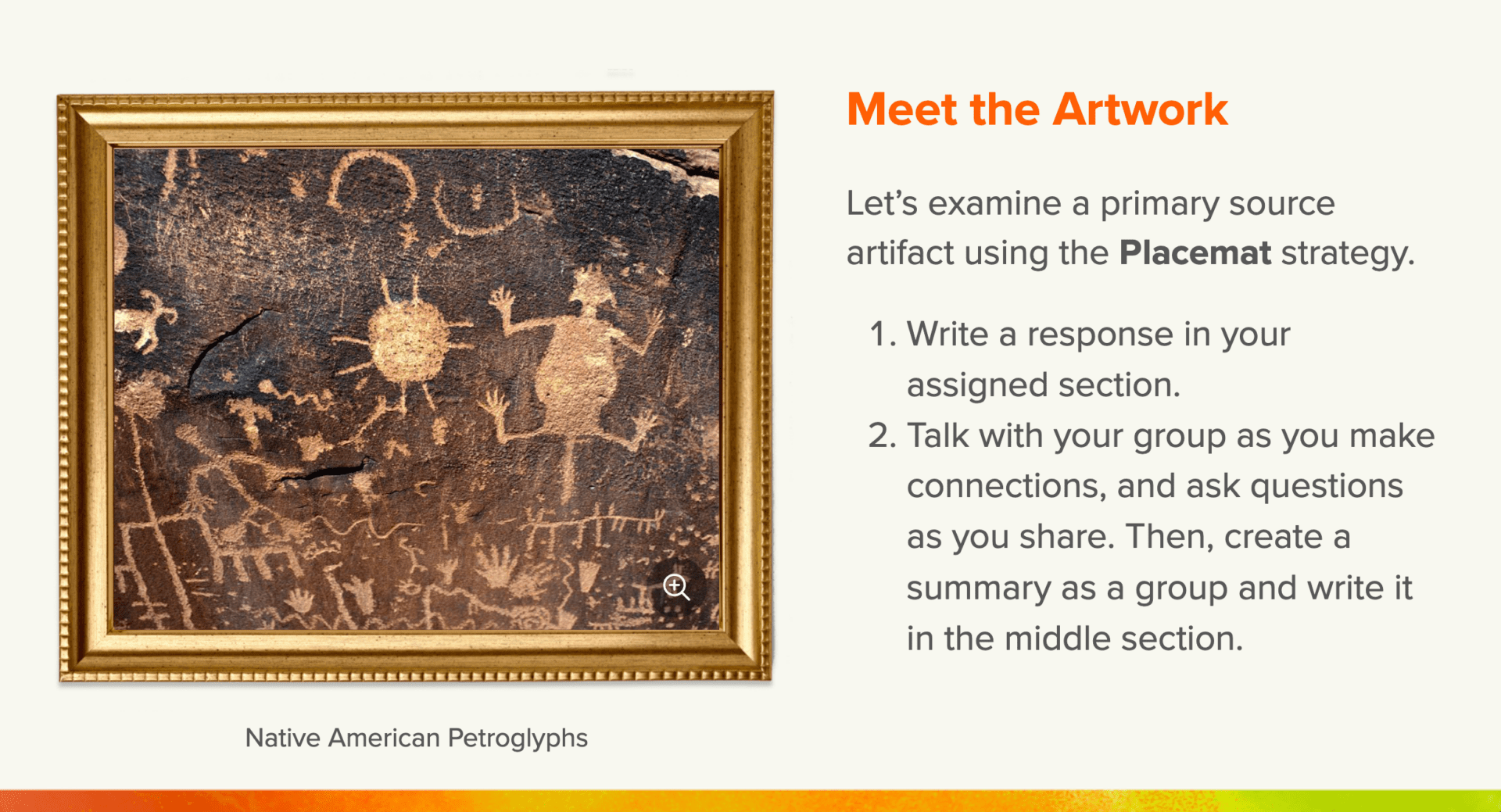
Social Studies Essentials leans into this approach. Students engage intentionally with primary and secondary sources through a mix of whole-group and small-group instruction, with strong modeling to guide them.
Each lesson features artifact exposure or analysis, reflection, and discussion to help students not only understand the content but also connect it to their own lives.
Social Studies Builds Critical Thinking and Communication Skills
Most importantly, social studies lessons don’t just ask students to absorb information. The lessons ask them to think and ask questions about what they have read. Who wrote this? Why? What perspective is missing? What evidence supports this claim? These habits turn passive readers into active, critical ones.
These are the same skills that standardized assessments, college courses, and real-world communication demand. Social studies is full of natural opportunities to practice. When a student is asked to determine which invention had the greatest impact on the world, the printing press or the compass, they must gather evidence, weigh competing claims, and build a case. This type of analysis sharpens reading and writing skills and builds literate students.
How does Discovery Education’s Social Studies Essentials improve critical thinking and communication?
Social Studies Essentials builds these skills into every lesson. Activities prompt students to practice writing, reading, listening, and speaking in small groups and whole–class discussions.
Students have regular, structured opportunities to sharpen their communication and critical thinking skills across multiple modes of communication.
Literacy Doesn't Develop in a Vacuum.
ELA instruction matters. Explicit instruction for decoding, fluency, comprehension strategies, and writing are all essential skills. But literacy doesn’t develop from only this type of instruction. It develops when students have rich knowledge, broad vocabulary, interesting reading experiences, and meaningful things to say. Social studies delivers all of that.
The most effective approach isn’t to choose between social studies and literacy. It’s to recognize that social studies is literacy instruction, and if we want to build a generation of thoughtful, capable, critical readers and writers, we need to start by giving them something worth reading and writing about.