Social studies helps students understand history, civics, communities, and the world around them, but fitting it into a busy school day can be challenging. Social Studies Essentials makes it more manageable with curated, standards-aligned resources grounded in the C3 Framework and designed to build literacy, inquiry, and critical-thinking skills. This sample lesson on the Constitution and Bill of Rights shows the program’s breadth and depth, with teacher-led instruction, rich content, and opportunities for students to discuss, question, and deepen their understanding.
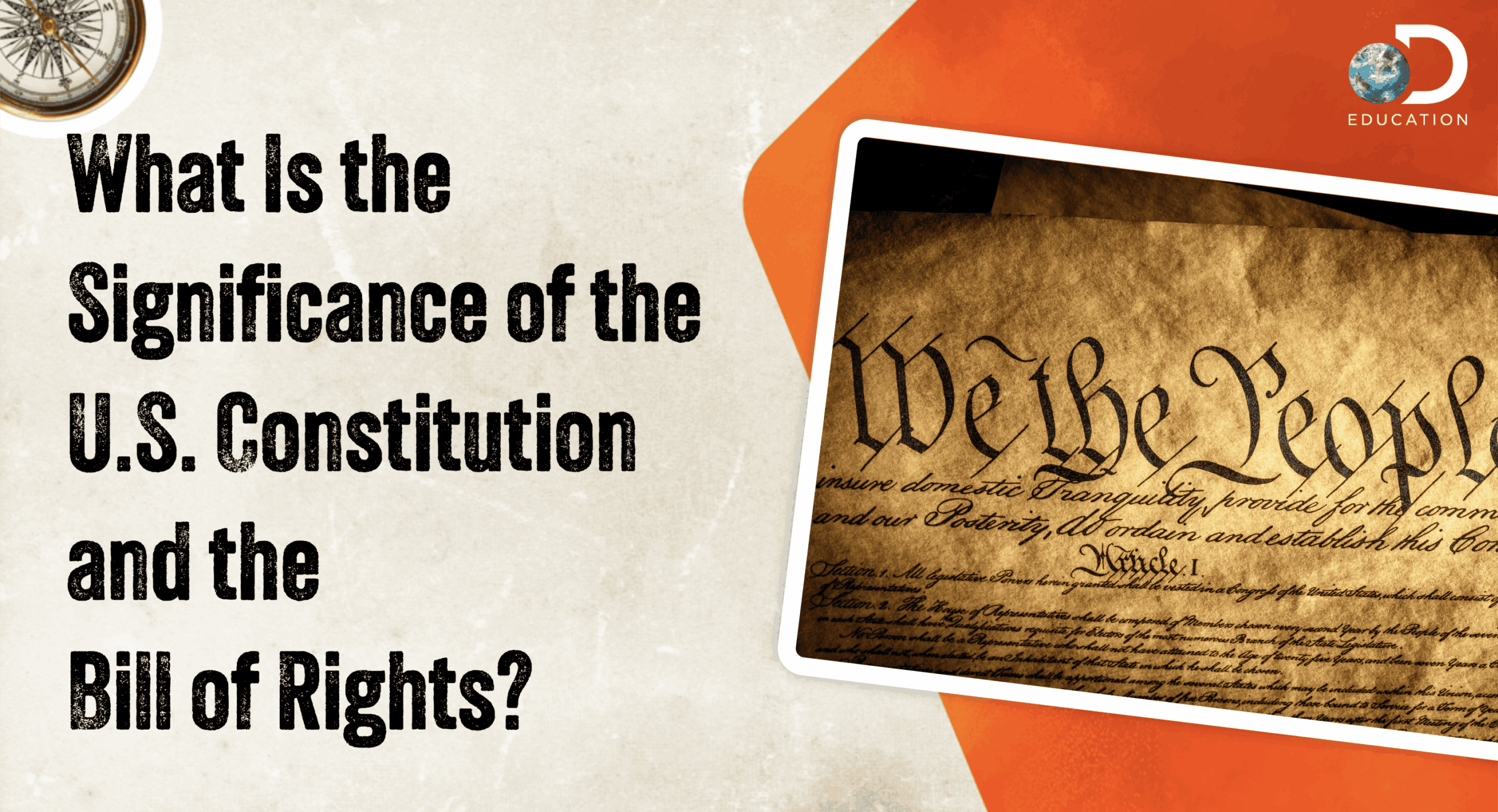
Fifth graders often hear that the Constitution and the Bill of Rights are important without a clear picture of why. This lesson starts with something they already understand, making rules, and builds toward a close look at a primary source from 1787.
This Constitution and Bill of Rights lesson plan helps students answer one question: What is the significance of the U.S. Constitution and the Bill of Rights? Below you will find every step of the lesson, including timing, teacher instructions, discussion questions, sample responses, differentiation ideas, and vocabulary.
Constitution and Bill of Rights Lesson Plan Overview
- Grade: 5
- Total time: 80 minutes (can be split into two 40-minute sessions; see the timing modification below)
- Lesson question: What is the significance of the U.S. Constitution and the Bill of Rights?
- Learning target: I will explain the significance of the U.S. Constitution and the Bill of Rights.
Lesson at a glance
- Introduction
- Think About It: instructional hook
- Prepare to Learn: learning target and graphic organizer
- Build Knowledge
- Read and Think
- Video and video transcript
- Analyze an Artifact
- Meet the Document: partner activity
- Discuss It: teacher-led discussion
- Make Sense of It: read aloud to clarify thinking
- Closing
- Make Connections: check for understanding
- Way to Go: learning target revisited
How to Prepare for the Lesson
Preparation
- Access the educator support document to support lesson planning.
- Assess students after the lesson.
Graphic organizer
- Print the graphic organizer and make a copy for each student.
- Ask students to record the Learning Target.
- Prompt students to take notes and generate questions throughout their learning.
Artifact activity
- Print the PDF Activity Preamble to the U.S. Constitution: Pin It.
- Make additional copies of pages 3 and 4 for each group of two students.
- Label four pieces of chart paper with the following titles: Observations, Recognizable Phrases, Unknown Vocabulary, and Questions. Post these charts in the classroom for students to use during the activity.
- Gather four different-colored sticky notes for each group of two students.
Differentiation
- Use Copy & Edit to modify this lesson to further meet your students’ needs.
- Use the Immersive Reader functionality to have words read aloud, enlarge the text, and create line-by-line focus.
Access this and many other social studies lesson plans with a free trial.
Constitution and Bill of Rights Lesson Plan: Step by Step
Think About It: Create Your Own Rules (5 minutes)
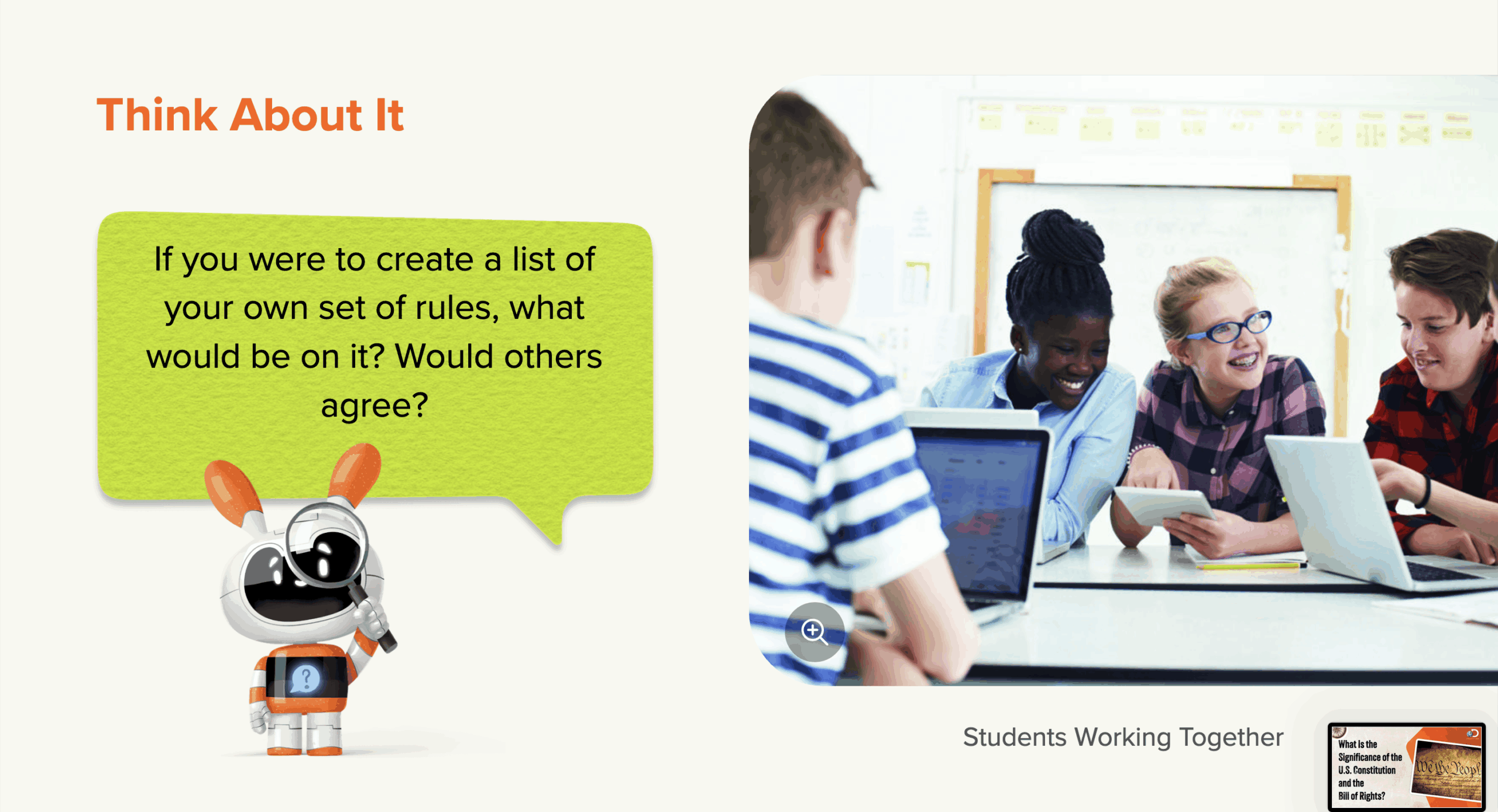
On the slide: Think About It. If you were to create a list of your own set of rules, what would be on it? Would others agree? The slide shows an image labeled Students Working Together.
Driving question: What is the significance of the U.S. Constitution and the Bill of Rights?
Suggestions for use
- Use the driving question and the guiding questions to prompt student discussion about creating your own set of rules.
- Provide space for students to discuss and ask questions that come to mind with a partner.
- Prompt students to continue thinking about the U.S. Constitution and Bill of Rights during this lesson.
Guiding questions to support discussion
- What new rule would you make for school? Why? Sample response: Answers will vary. Accept all reasonable responses.
- What new rule would you make for home? Why? Sample response: Answers will vary. Accept all reasonable responses.
- Does everyone else have to follow your new rules? Why? Sample response: Answers will vary. Accept all reasonable responses.
Prepare to Learn (3 minutes)
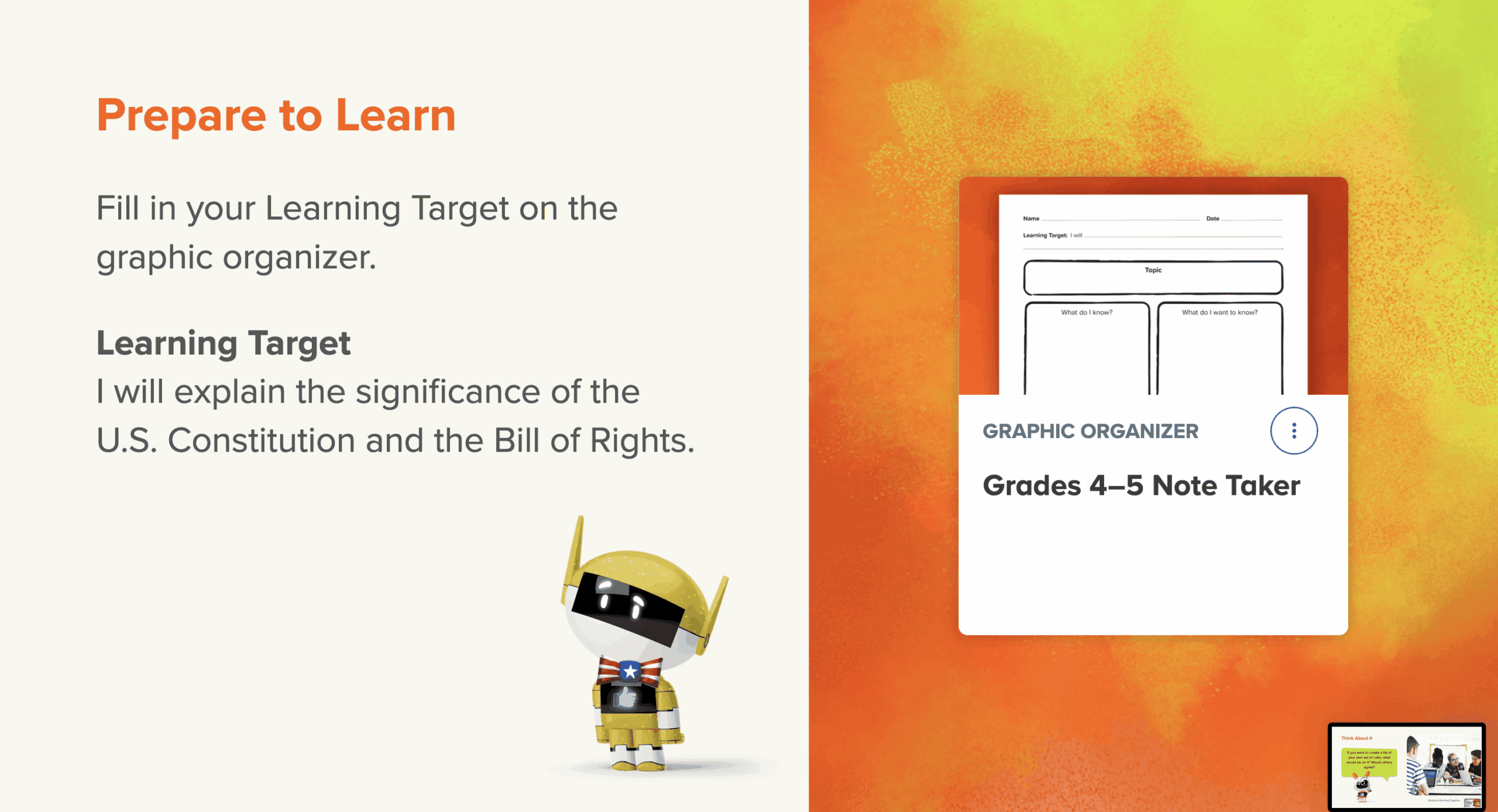
On the slide: Prepare to Learn. Fill in your Learning Target on the graphic organizer. The slide shows the learning target and a Grades 4 to 5 Note Taker graphic organizer.
Learning target: I will explain the significance of the U.S. Constitution and the Bill of Rights.
Suggestions for use
Provide students with support to capture their thinking throughout their learning.
- Print the graphic organizer.
- Ask students to record the Learning Target.
- Prompt students to take notes and generate questions throughout their learning.
Read and Think (10 minutes)
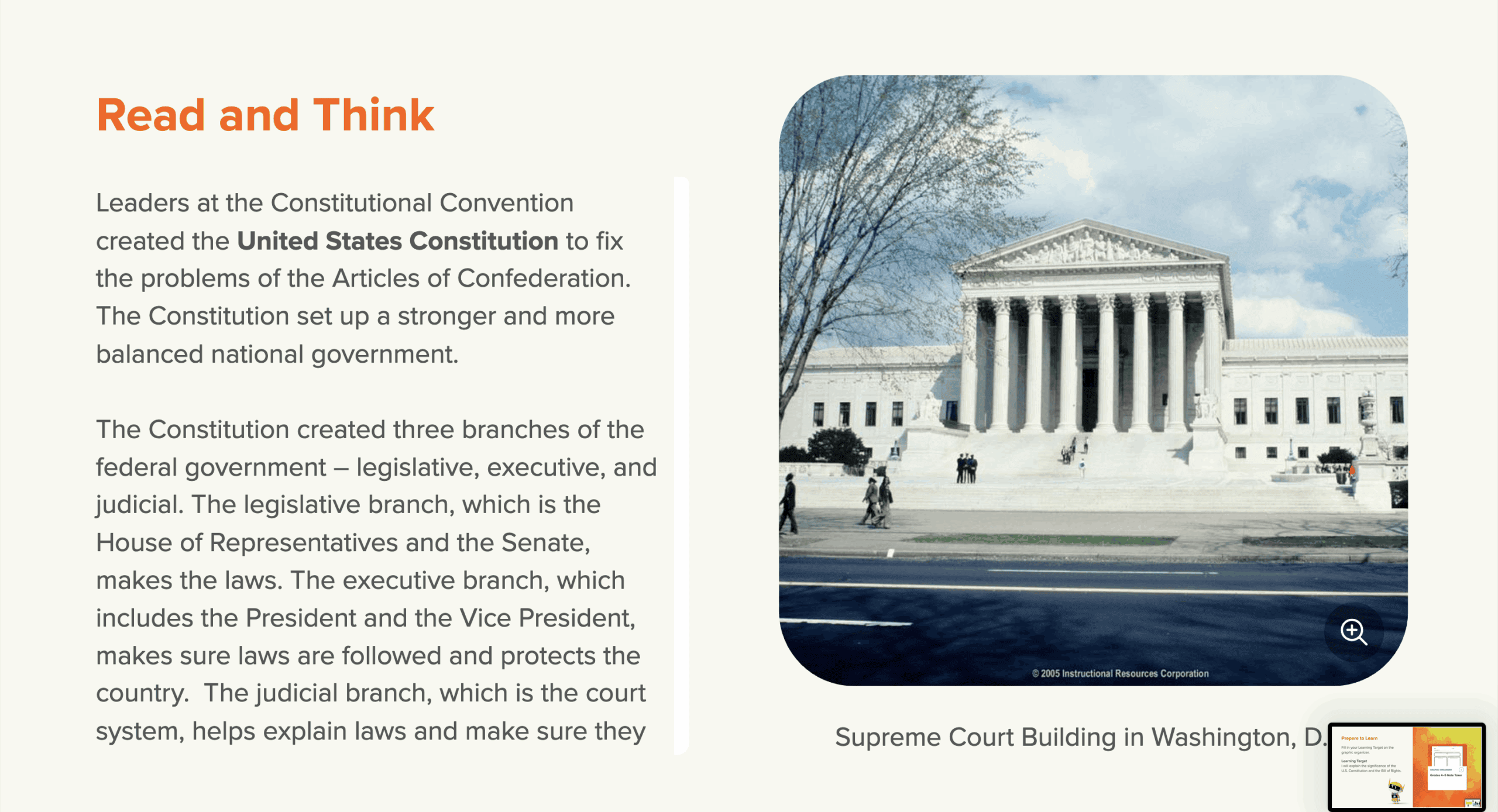
On the slide: Read and Think. Leaders at the Constitutional Convention created the United States Constitution to fix the problems of the Articles of Confederation. The Constitution set up a stronger and more balanced national government. The Constitution created three branches of the federal government: legislative, executive, and judicial. The legislative branch, which is the House of Representatives and the Senate, makes the laws. The executive branch, which includes the President and the Vice President, makes sure laws are followed and protects the country. The judicial branch, which is the court system, helps explain laws and make sure they… (the text on the slide is cut off in the lesson notes PDF). An image of the Supreme Court Building in Washington, D.C. appears beside the text.
Suggestions for use
- Ask students to write down key words and facts from the description.
- Have students discuss the topic with one another and share their thoughts.
- Prompt students to jot down any questions or curiosities that they have.
- Facilitate a class discussion to share observations, knowledge, and questions, connecting them to the broader historical context.
Vocabulary
Teach the definitions of the bolded keywords to ensure student comprehension of key vocabulary in this lesson:
- United States Constitution: a document about the laws, rights, and government in the United States; in effect since 1787
- checks and balances: a system that makes sure different parts of the government work together fairly and no one gets too much power
- Bill of Rights: the first ten amendments, or changes, to the U.S. Constitution that protect people’s rights
- amendment: an official change made to a document
Differentiation
- Pair students for support in reading and recording key words and facts.
- Provide sentence starters or a word bank to help students express their understanding, connections, and questions.
- Challenge advanced students to connect their notes and questions to research or further exploration.
Watch to Learn (10 minutes)
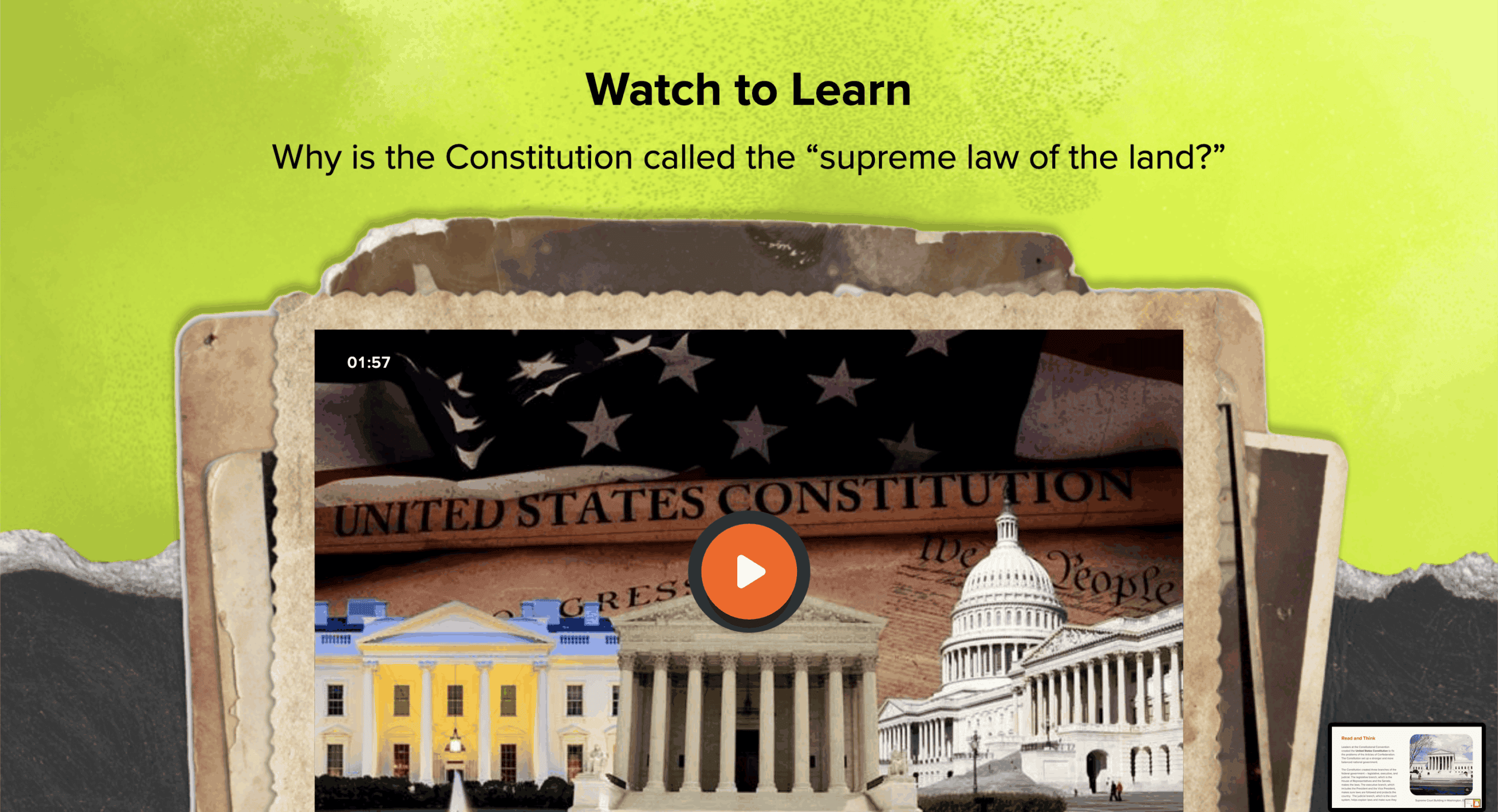
On the slide: Watch to Learn. Why is the Constitution called the “supreme law of the land?” The video runs 1 minute and 57 seconds.
Suggestions for use
- Direct students to look for evidence in the video that answers the question prompt: Why is the Constitution called the “supreme law of the land?”
- Why is the Constitution called the “supreme law of the land?” Sample response: The Constitution is called the “supreme law of the land” because it is the highest set of rules for the country. All other laws must follow it. If a law goes against the Constitution, judges can say that law is not allowed. This keeps government leaders and laws from breaking the basic rules that protect everyone.
- Play the media for the class, and remind students to take notes on their graphic organizer.
- Utilize the Fullscreen option to show the video fullscreen.
- Allow students to discuss their answers to the question prompt with a partner.
- Direct students to generate additional questions that they would like to learn about on their graphic organizer.
- Revisit the lesson’s driving question: What is the importance of the U.S. Constitution and the Bill of Rights?
Differentiation
- Print the video transcript PDF and ask students to annotate the text to support a close reading strategy.
Reflect On It: Propose an Amendment (5 minutes)
On the slide: Reflect On It. What amendments would you propose to the U.S. Constitution? Why? The slide shows an image labeled A Student Writing on Paper.
Suggestions for use
- Read the question to help students reflect on changes they might make to the U.S. Constitution:
- What amendments would you propose to the U.S. Constitution? Why? Sample response: Answers will vary. Accept all reasonable responses.
- Provide time for students to share their responses with the class or a partner.
- Summarize student responses about changes they might make to the U.S. Constitution.
Analyze an Artifact: Introduce the Activity (1 minute)
On the slide: Analyze an Artifact. Now that you’ve started thinking about the importance of the U.S. Constitution and the Bill of Rights, let’s take a look at a document focused on this time in history.
These four slides provide a classroom activity to enable students to analyze a historic artifact and communicate their findings in order to better understand the U.S. Constitution and the Bill of Rights.
Complete the artifact activity preparation steps listed earlier in this post before you begin.
Meet the Document: Pin It (10 to 15 minutes)
Format: Partner collaboration
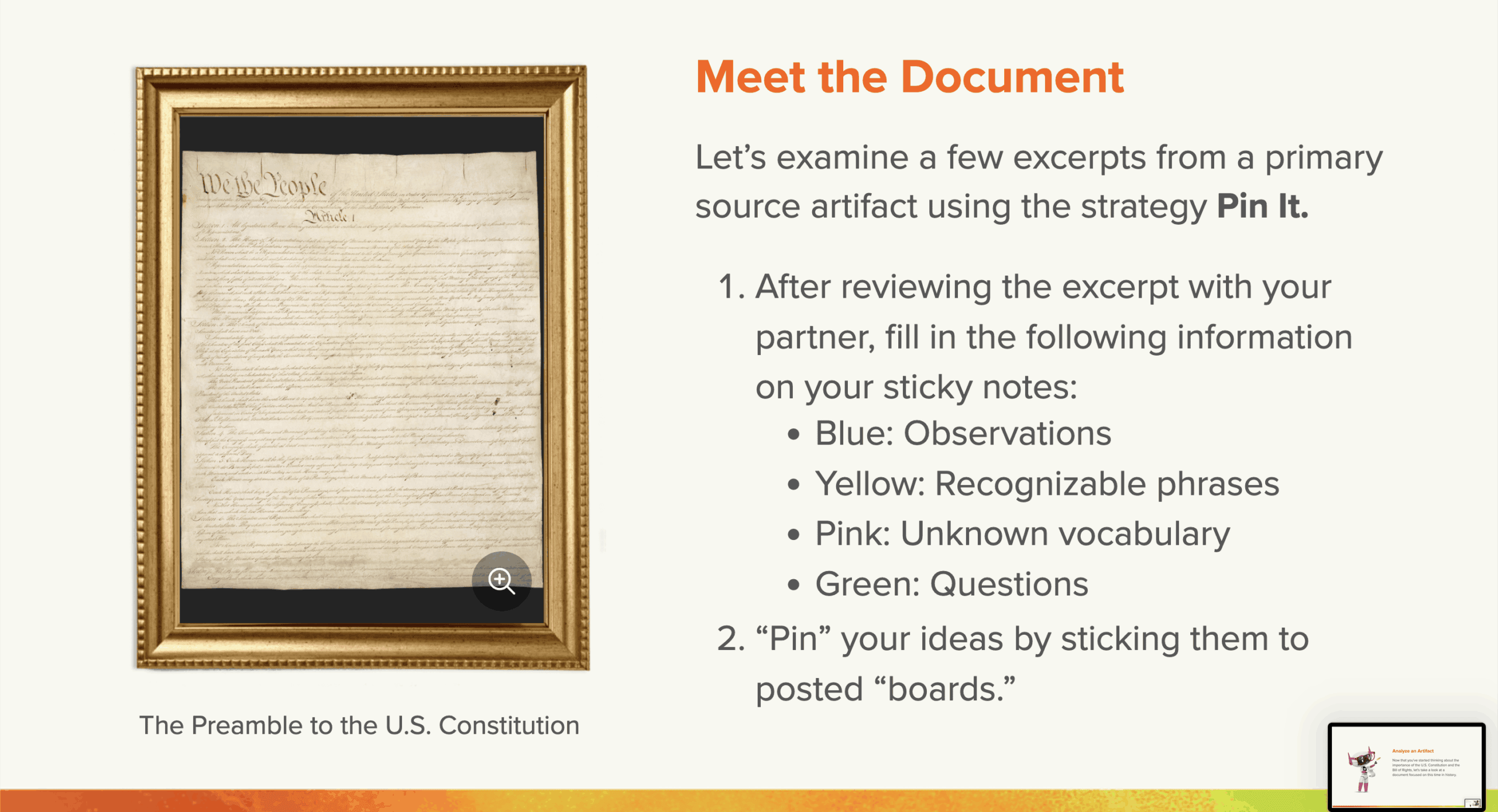
On the slide: Meet the Document. Let’s examine a few excerpts from a primary source artifact using the strategy Pin It. 1. After reviewing the excerpt with your partner, fill in the following information on your sticky notes: Blue: Observations. Yellow: Recognizable phrases. Pink: Unknown vocabulary. Green: Questions. 2. “Pin” your ideas by sticking them to posted “boards.” The slide shows an excerpt of The Preamble to the U.S. Constitution.
Activity instructions
- Present this slide to remind students of the Pin It strategy instructions.
- Assign students into groups of two and introduce students to the excerpt.
- Pass out copies of pages 3 and 4 of the PDF Activity Preamble to the U.S. Constitution: Pin It to each group.
- Examine the artifact with the students and encourage them to consider the big idea. Have students click on the image to read the document excerpt.
- Introduce the Pin It: Partner Brainstorming sheet (page 4 of the PDF Activity).
- Set a timer for five minutes. Direct each group to review the excerpt and search for answers to the prompts on the Partner Brainstorming sheet.
- Distribute four sticky notes, one of each color, to each group.
- Remind groups to write the color sticky note designated for each section on their brainstorming sheet. For example:
- Blue: Observations
- Yellow: Recognizable Phrases
- Pink: Unknown Vocabulary
- Green: Questions
- Set a timer for five minutes, asking each group to choose one item from each section of their Partner Brainstorming sheet and write on the corresponding sticky note.
- Have partners “pin” their selected ideas by placing their sticky notes on the four pieces of chart paper posted around the room.
- Bring the class back together and lead the Discuss It slide discussion.
Suggestions for use
- Select the Zoom icon for students to view the image larger.
- This activity was inspired by the SOS Instructional Strategy Pin It. To learn more about this strategy, check out the following resources: the Pin It PDF activity, the Pin It full video, and the Pin It for Students video.
Discuss It (10 minutes)
Format: Teacher-led classroom discussion
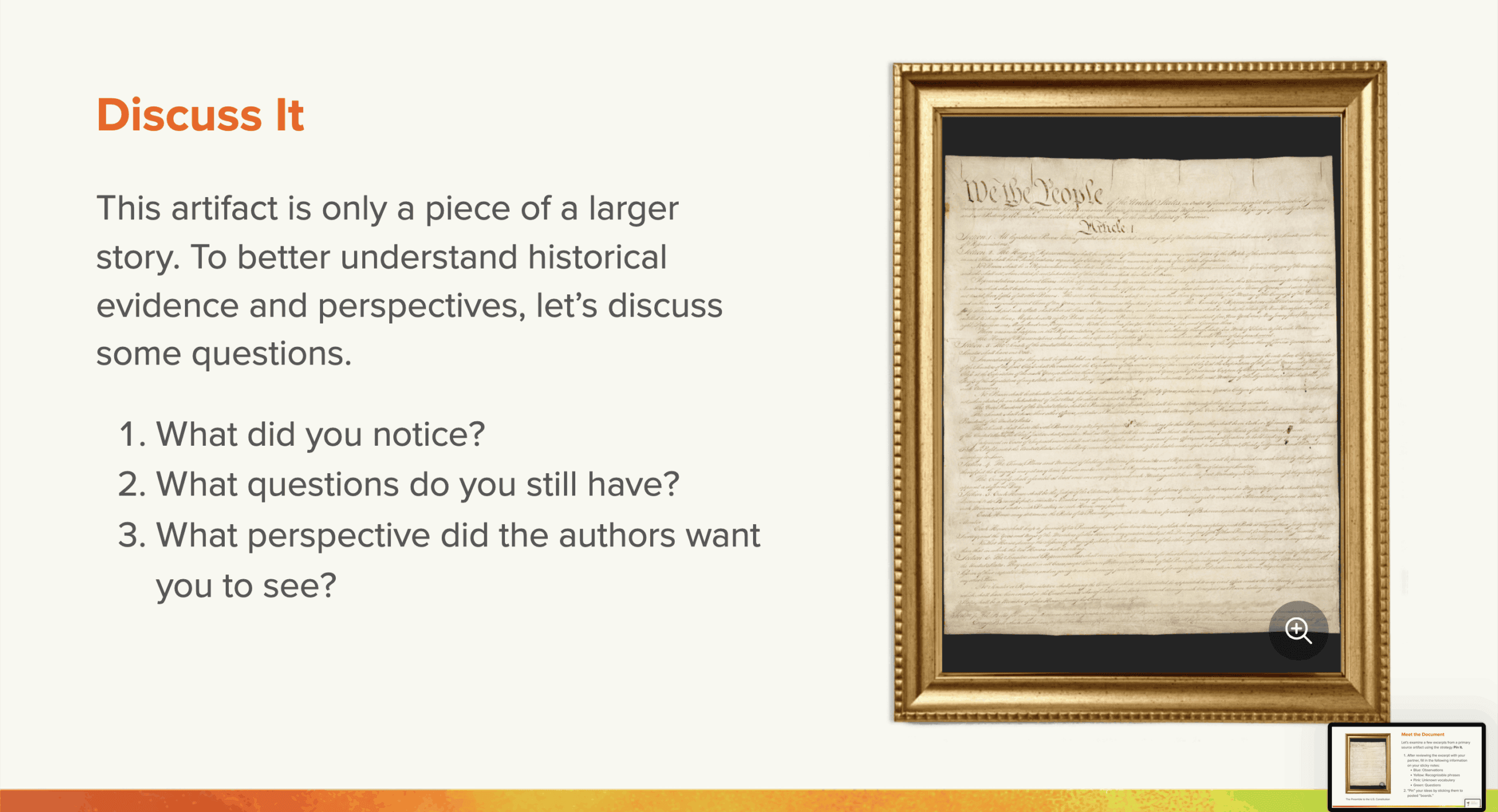
On the slide: Discuss It. This artifact is only a piece of a larger story. To better understand historical evidence and perspectives, let’s discuss some questions. 1. What did you notice? 2. What questions do you still have? 3. What perspective did the authors want you to see?
Activity instructions
- Ask students to return to their seats, if they have not already.
- Clarify any questions about specific comments from students’ responses.
- Read each question prompt on the slide and provide students with the opportunity to share their thinking.
- Focus on enabling student discourse, without approving or disapproving their answers.
- Clarify students’ thinking on the next slide, Make Sense of It.
Teacher tip: Understanding perspectives in artifacts. Each individual has a unique viewpoint that is influenced by their background, beliefs, and experiences. When people create something, they bring their own distinctive perspective to their work.
Make Sense of It (11 minutes)
Format: Teacher-led read aloud
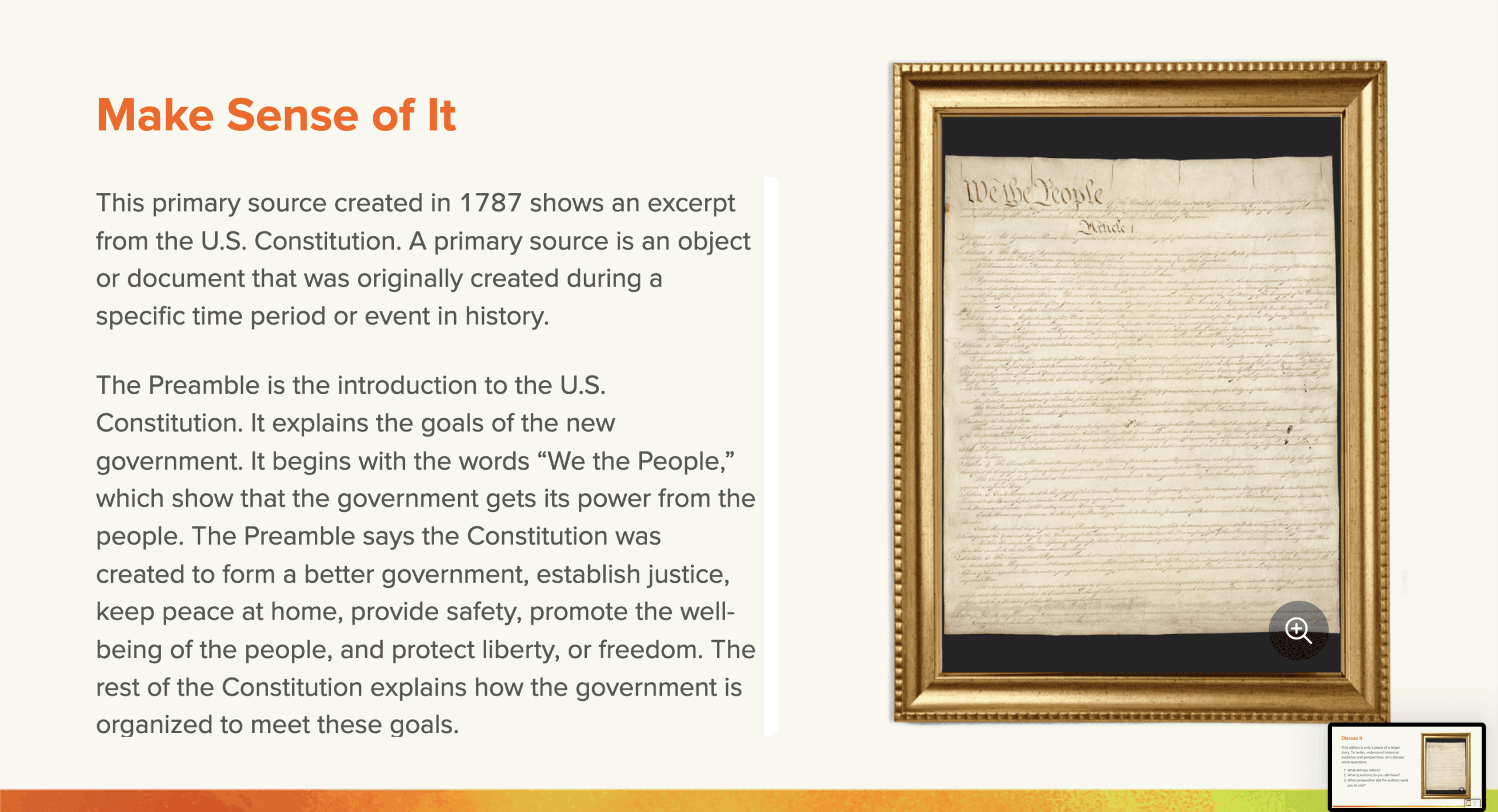
On the slide: Make Sense of It. This primary source created in 1787 shows an excerpt from the U.S. Constitution. A primary source is an object or document that was originally created during a specific time period or event in history. The Preamble is the introduction to the U.S. Constitution. It explains the goals of the new government. It begins with the words “We the People,” which show that the government gets its power from the people. The Preamble says the Constitution was created to form a better government, establish justice, keep peace at home, provide safety, promote the well-being of the people, and protect liberty, or freedom. The rest of the Constitution explains how the government is organized to meet these goals.
Activity instructions
- Read the text aloud using the scroll bar.
- Pause to address specific misconceptions that students shared during the class discussion.
- Direct students to update any misconceptions captured on their graphic organizers. For example, students might need to cross out incorrect ideas or add important information that is missing.
- Learn more about the source using the About the Document section.
Differentiation
- Use the Immersive Reader functionality to have words read aloud, enlarge the text, and create line-by-line focus.
Make Connections (10 minutes)
Format: Closing and check for understanding
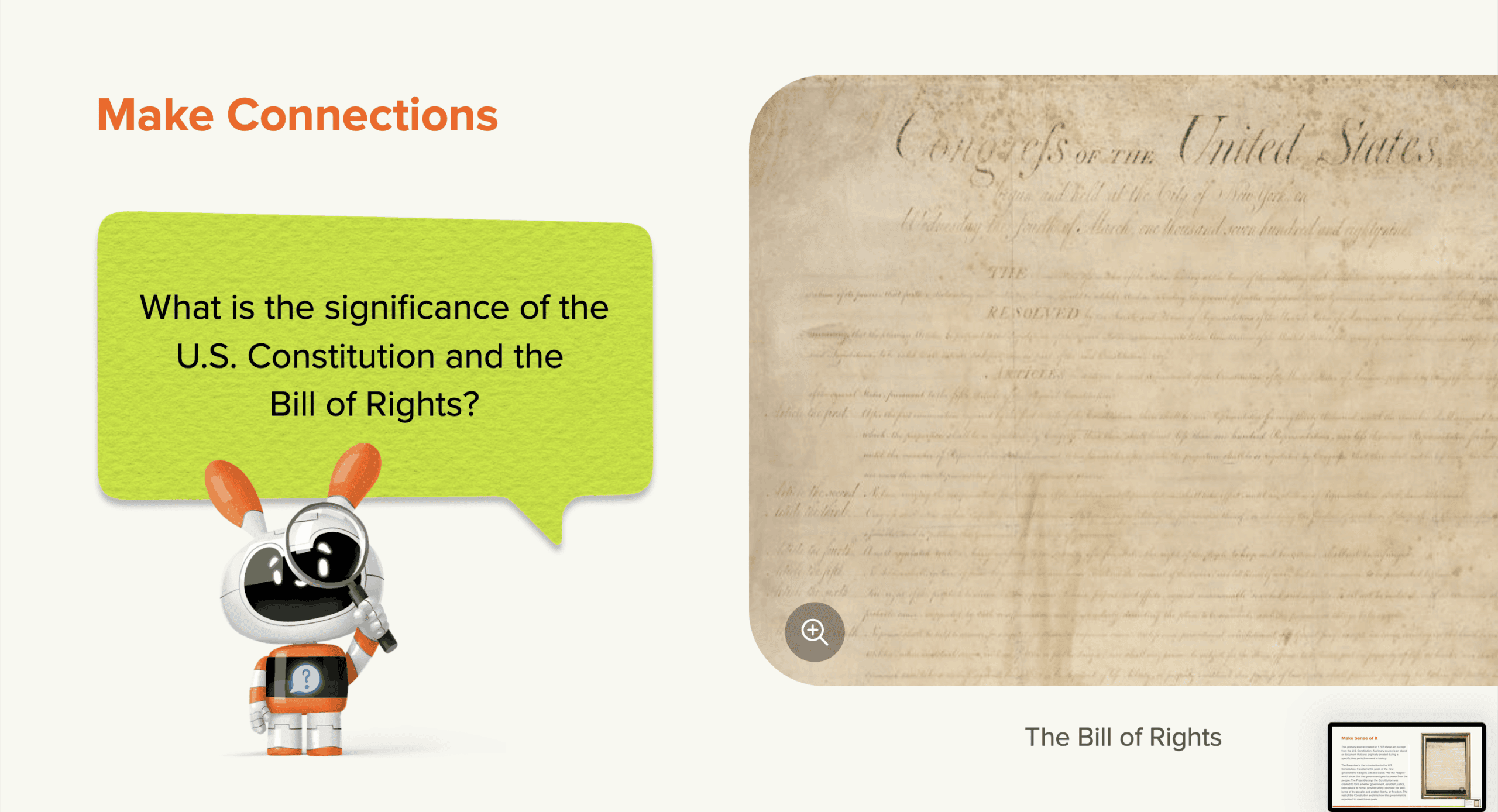
On the slide: Make Connections. What is the significance of the U.S. Constitution and the Bill of Rights? The slide shows an image labeled The Bill of Rights.
Suggestions for use
- See if students can synthesize the information provided on the previous slide to answer the question prompt: What is the significance of the U.S. Constitution and the Bill of Rights?
- Sample response: The Constitution is important because it is the nation’s supreme law. It creates the government, limits its power, and protects citizens.
- Sample response: The Bill of Rights (the first ten amendments) is important because it lists essential freedoms that the government must respect. It can be changed through amendments so it can adapt over time.
- Sample response: The Constitution and Bill of Rights are important because they define, guide, and protect the citizens of our nation.
- Make connections to the concept of the importance of the U.S. Constitution and Bill of Rights and students’ lives today. For example, knowing your rights helps you understand news, court cases, and government actions. It empowers you to speak up, vote when eligible, and protect your freedoms.
Way to Go: Revisit the Learning Target
On the slide: Way to Go! You’ve learned about the significance of the U.S. Constitution and the Bill of Rights.
This closing slide revisits the learning target. The lesson notes do not include a teacher note or a time for this slide.
Key Vocabulary for the Constitution and Bill of Rights Lesson
- United States Constitution: a document about the laws, rights, and government in the United States; in effect since 1787
- checks and balances: a system that makes sure different parts of the government work together fairly and no one gets too much power
- Bill of Rights: the first ten amendments, or changes, to the U.S. Constitution that protect people’s rights
- amendment: an official change made to a document
Timing Modification: Split the Lesson Into Two Sessions
This lesson could be split into two 40-minute sessions:
Part 1: Introduce the lesson using slides 1 to 3. Then, use slides 4 to 5 to build knowledge by reading text and watching a video related to the importance of the U.S. Constitution and the Bill of Rights. Use slide 6 to engage students with a reflection question.
Part 2: Use slides 7 to 10 to analyze an artifact that connects to the importance of the U.S. Constitution and the Bill of Rights. Use slide 11 to engage students with the lesson question.
Helping Students See Why the Constitution Matters
Students leave this Constitution and Bill of Rights lesson plan with more than a list of documents and dates. They see the Constitution as the nation’s supreme law, the Bill of Rights as a list of freedoms the government must respect, and the Preamble as a statement that government gets its power from the people. Writing their own rules, analyzing a primary source with a partner, and connecting the ideas to life today gives students several ways to explain why these documents matter.
Access this and many other social studies lesson plans with a free trial.