Social studies helps students understand history, civics, communities, and the world around them, but fitting it into a busy school day can be challenging. Social Studies Essentials makes it more manageable with curated, standards-aligned resources grounded in the C3 Framework and designed to build literacy, inquiry, and critical-thinking skills. This sample lesson on community helpers shows the program’s breadth and depth, with teacher-led instruction, rich content, and opportunities for students to discuss, question, and deepen their understanding.
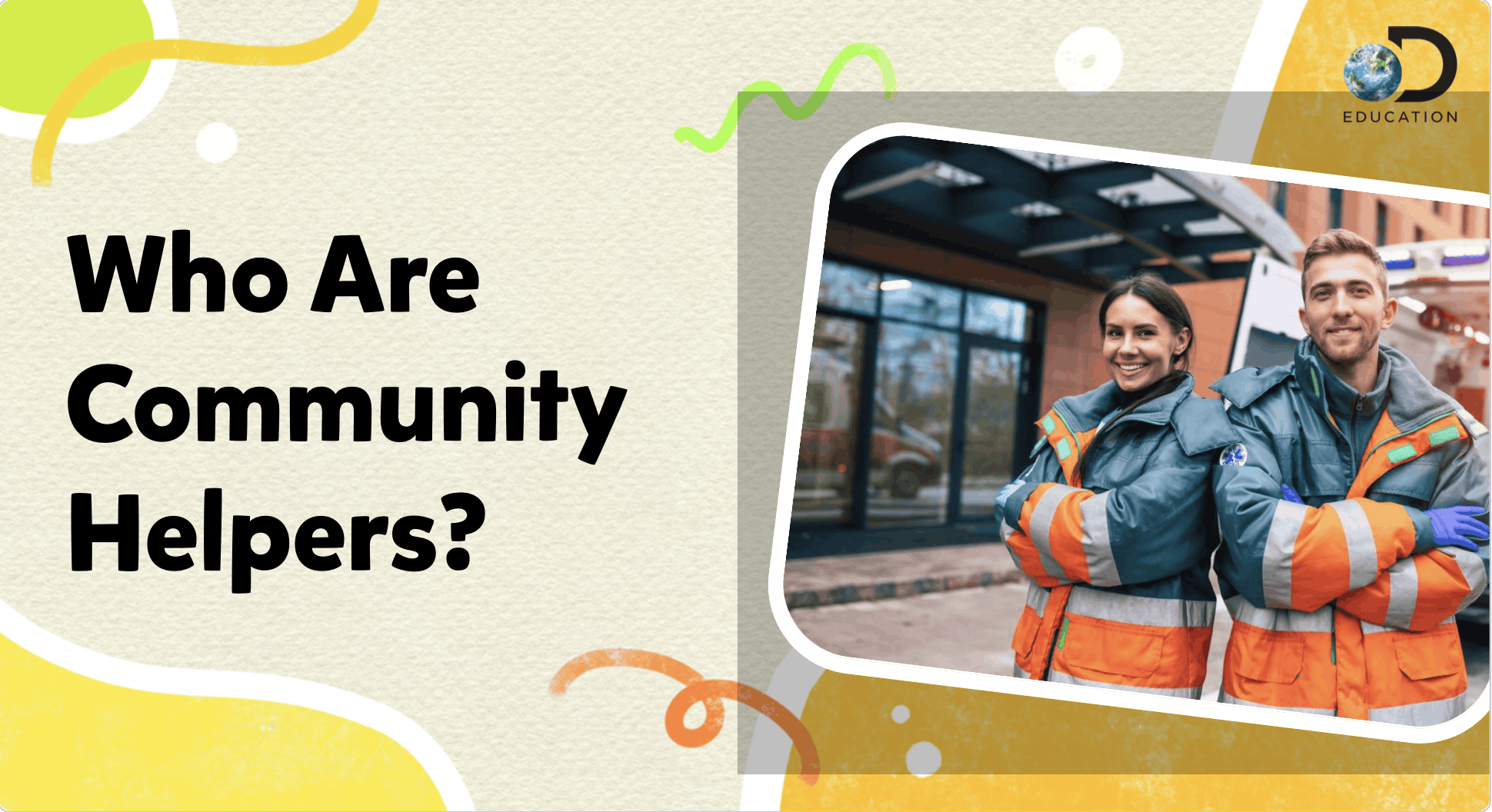
Kindergartners see community helpers every day, from the person who delivers the mail to the teacher at the front of the classroom. They may not yet have a name for what those people have in common.
This community helpers lesson plan helps students answer one question: Who are community helpers? They watch a video, look closely at pictures, and participate in an activity to apply what they learn to everyday life. Below you will find every step of the lesson, including timing, discussion questions, sample responses, differentiation ideas, and vocabulary.
Community Helpers Lesson Plan Overview
- Grade: Kindergarten
- Total time: 40 minutes (can be split into two 20-minute sessions; see the timing modification below)
- Lesson question: Who are community helpers?
- Learning target: Today, we will identify community helpers.
Lesson overview: This lesson explores community helpers. Students will watch a video and participate in an activity to apply what they learn to everyday life.
How to Prepare and Present the Lesson
Preparation
- Access the educator support document to support lesson planning.
- Assess students after the lesson.
Suggestions for use
This is a lesson presentation to support instruction. Use the Present to Class button to view fullscreen.
The lesson moves through five stages:
- Slide 3: Hook students’ interest to learn more about community helpers.
- Slides 4 to 6: Build knowledge by watching a video and reading definitions about jobs and community helpers.
- Slide 7: Encourage students to reflect on community helpers.
- Slide 8: Lead students through an activity that connects to the lesson topic.
- Slide 9: Provide students with an opportunity to apply what they learned about community helpers.
Differentiation
Check for strategy-specific differentiation support in the Teacher Notes throughout this lesson. You can also use Copy & Edit to modify this lesson to further meet your students’ needs.

Access this and many other social studies lesson plans with a free trial.
Community Helpers Lesson Plan: Step by Step
Learning Target (2 minutes)
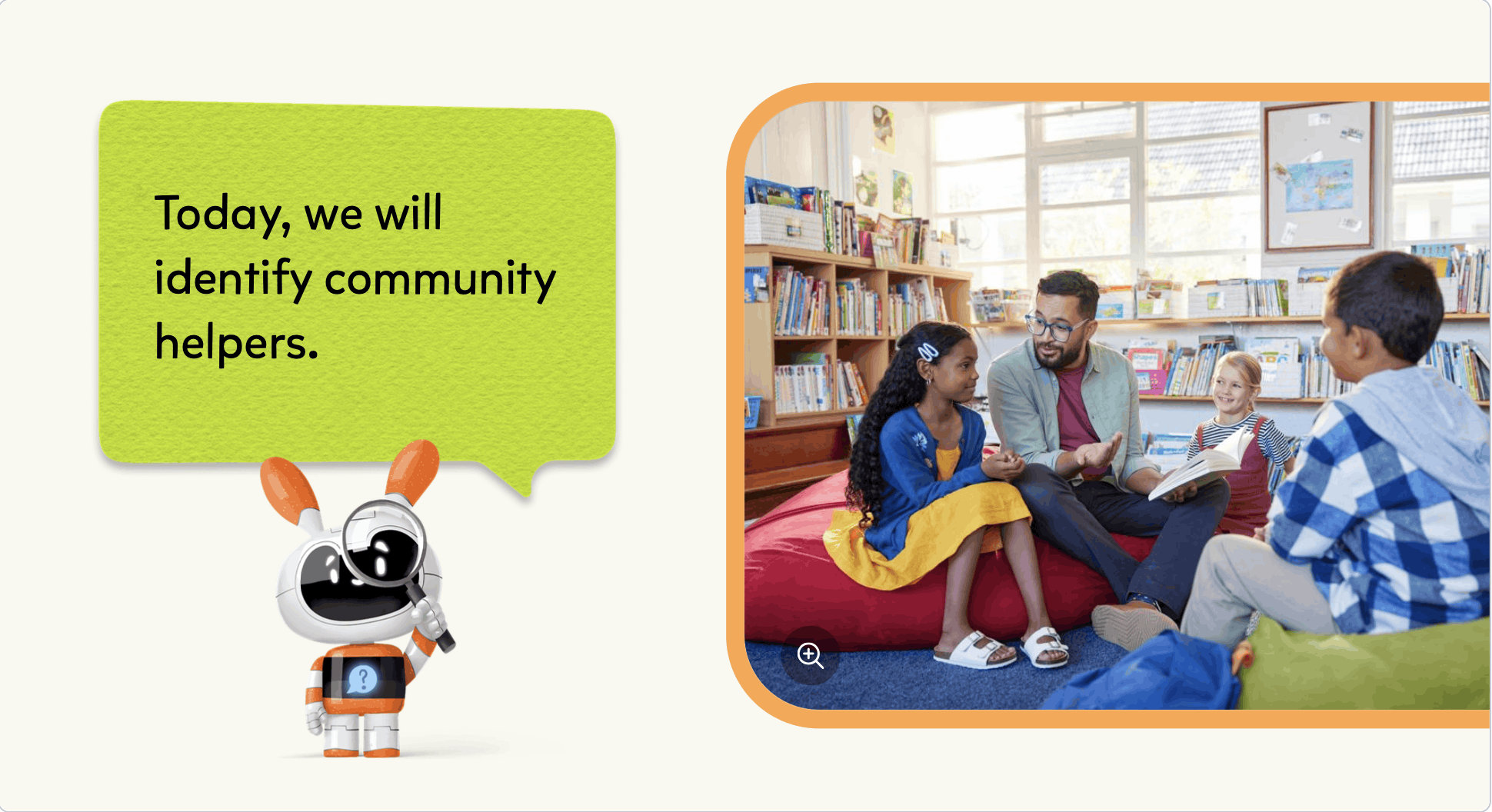
On the slide: Today, we will identify community helpers.
Learning target: Today, we will identify community helpers.
Let’s Look: Hook Students With Eye Spy (5 minutes)
Strategy: Eye Spy
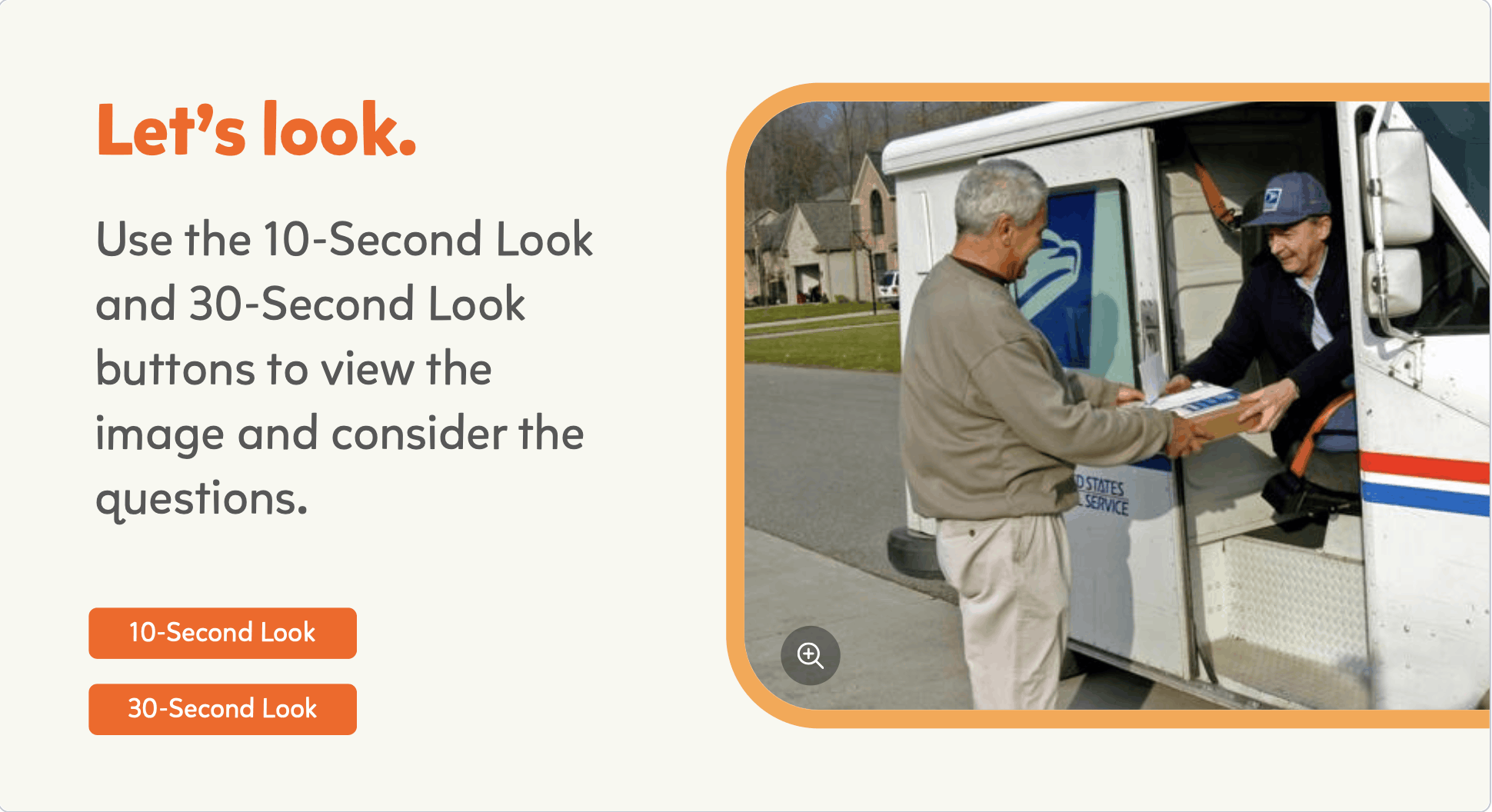
On the slide: Let’s look. Use the 10-Second Look and 30-Second Look buttons to view the image and consider the questions.
Suggestions for use
- Use Present to Class with this slide to get students thinking about what they know about community helpers.
- Zoom in on the image and present it for 10 seconds.
- Hide the image by clicking on the 10-Second Look button.
- Ask students to consider:
- What is happening in the image? Sample response: Answers will vary. Accept all reasonable responses.
- Provide time for students to share their responses with a partner or write their responses on a scrap piece of paper or a sticky note.
- Close the pop-up window.
- Zoom in on the image again and present it for 30 seconds.
- Hide the image by clicking on the 30-Second Look button.
- Have students discuss:
- What things did you see in the image? Sample response: Answers will vary. Accept all reasonable responses.
- Provide time for students to share their responses with a partner or write their responses on a scrap piece of paper or a sticky note.
- Summarize student responses and transition to what students will learn in the activity.
Differentiation
If students need help, use these questions as a scaffold:
- How many people are in the picture? Sample response: There are two people in the picture.
- What are the two people doing? Sample response: Someone is giving a package, and someone is taking it.
- Students can work with a partner to develop observations.
Hook strategy support: This hook strategy was inspired by the instructional strategy Eye Spy. Refer to the Eye Spy strategy guide for additional support.
Watch to Learn (10 minutes)
Use this video to learn about community helpers.
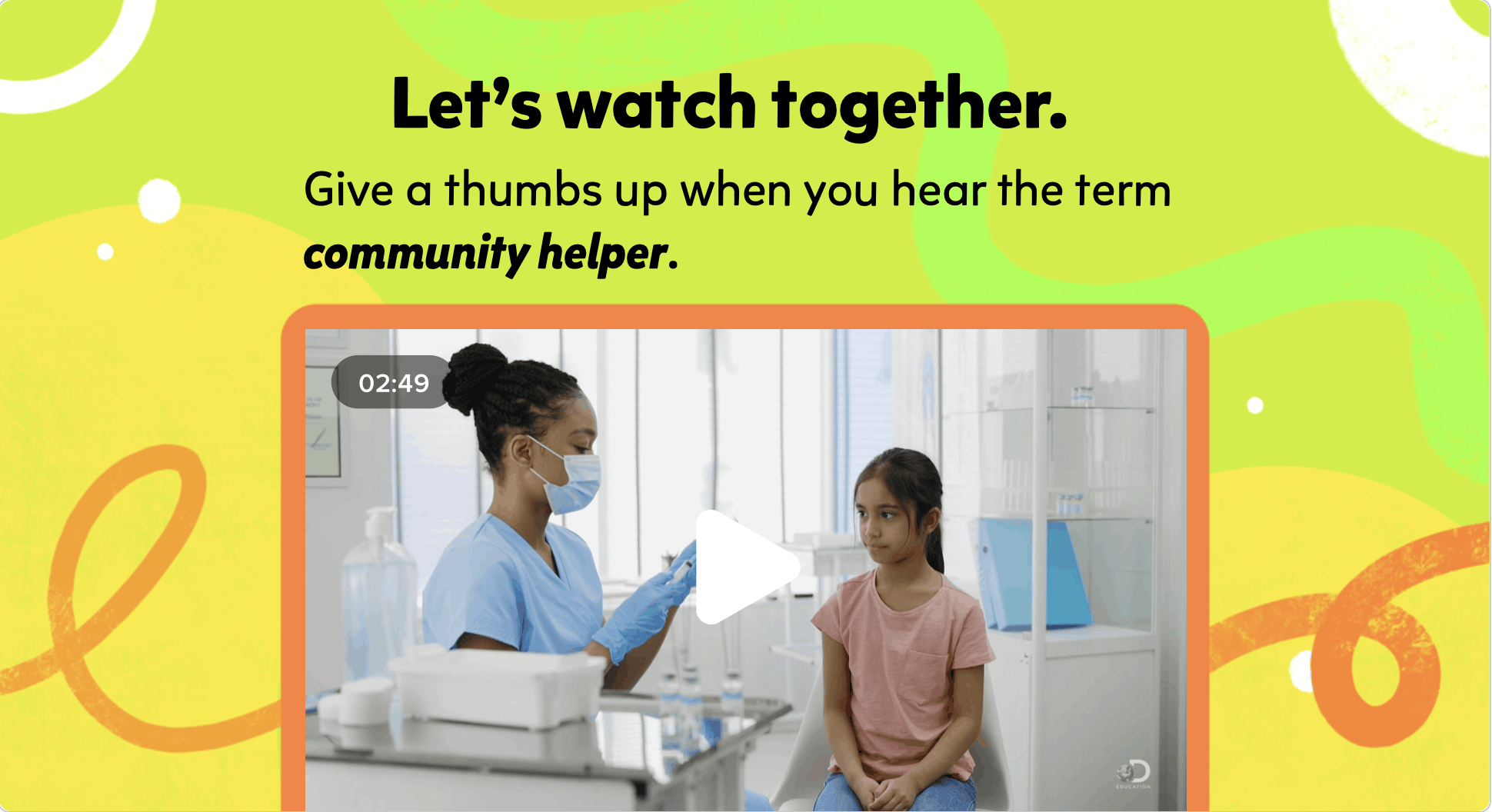
On the slide: Let’s watch together. Give a thumbs up when you hear the term community helper. The video runs 2 minutes and 49 seconds.
Suggestions for use
- Ask students to give a thumbs up when they hear the term community helper.
- After playing the video, check for students’ understanding of the meaning of:
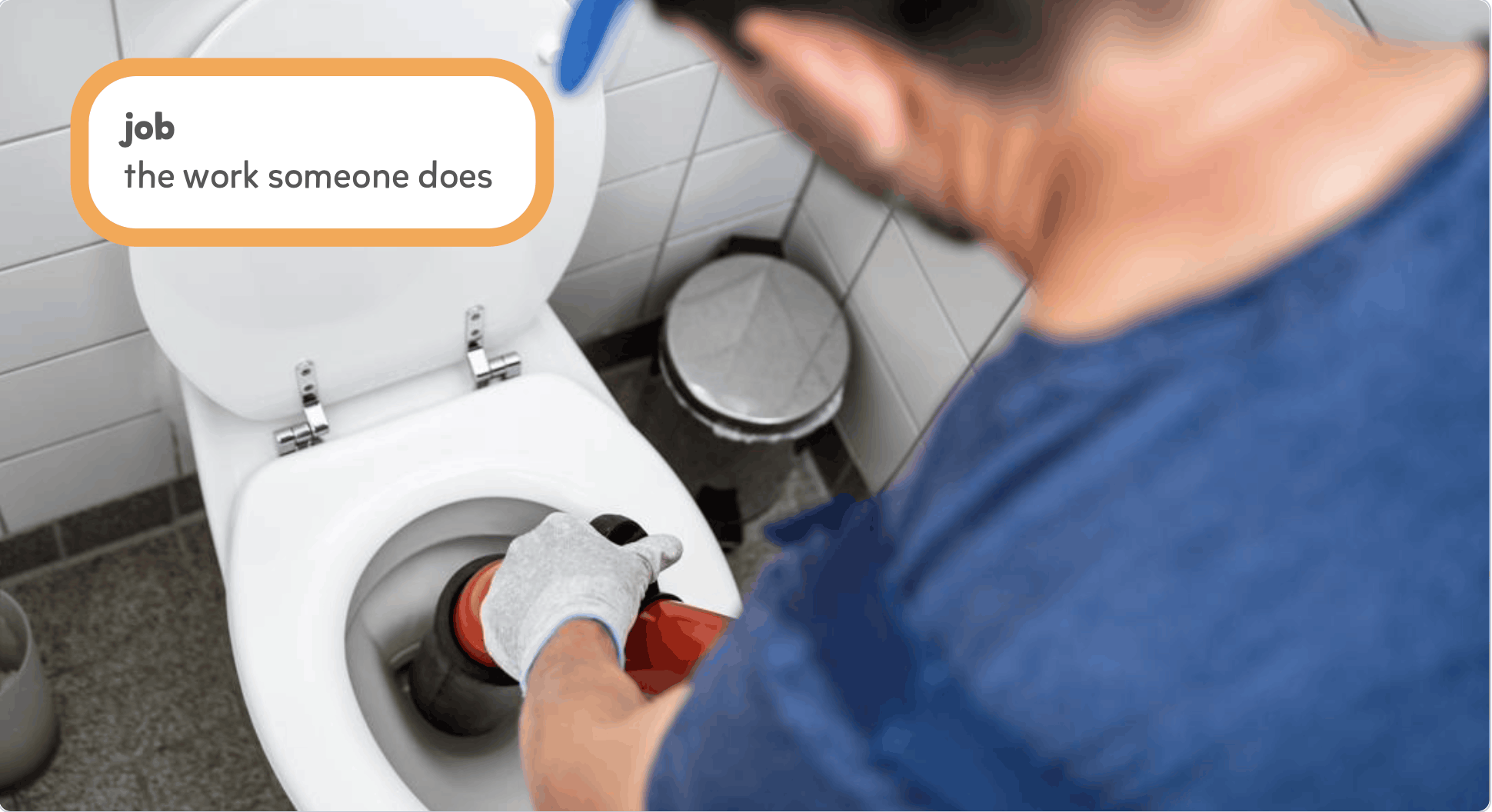
- job: the work someone does
- community helper: a person who works at a job that helps a community
- Provide time for students to share what they saw and heard with the class or a partner.
- Summarize student responses about community helpers.
- If there is time, play the video again for students, pausing as needed, letting them comment on anything new they learned.
Differentiation
- Students’ observations can be shared through partner, small-group, or class discussions.
- Ask questions to scaffold students’ observations:
- Who did you see helping in the video, and what were they doing to help? Sample response: I saw the dentist, doctor, and nurse all helping us stay healthy.
- What might happen if these community helpers were not there to help us? Sample response: We might get sick more if we didn’t have the doctors and nurses, and we wouldn’t have clean healthy teeth without dentists.
- How is being a community helper different from helping at home? Sample response: A community helper has a job that helps more people than just the people in a home.
Lesson Vocabulary: Job (3 minutes)
Use this slide to reinforce students’ understanding of the term job.
On the slide: job: the work someone does.
Suggestions for use
- Have students look at the image. Ask:
- What do you notice? Sample response: Answers will vary. Accept all reasonable responses.
- Read the text with your class. Ask:
- What job might this person be doing? Sample response: The person is fixing the toilet.
- Where does he do his job? Sample response: He does his job in bathrooms.
- What is the name of this job? Sample response: This job is called a plumber.
- What other kinds of jobs do people do? Sample response: Other jobs are teacher, police officer, or cleaner.
Differentiation
Ask questions to scaffold students’ observations:
- What is the man holding? Sample response: He is holding a tool.
- Why is he there? Sample response: Maybe the toilet is broken.
- What might happen next? Sample response: Maybe the toilet will be fixed, and people can use it again.
Lesson Vocabulary: Community Helper (3 minutes)
Use this slide to reinforce students’ understanding of the term community helper.
On the slide: community helper: a person who works at a job that helps a community.
Suggestions for use
- Have students look at the image. Ask:
- What do you notice? Sample response: Answers will vary. Accept all reasonable responses.
- Read the text with your class. Ask:
- What job do you see? Sample response: I see a person giving a haircut. I see a barber.
- How does this job help the community? Sample response: People get haircuts to feel good and cut their hair when it gets very long. Barbers also talk to the people in their communities.
Differentiation
Ask questions to scaffold students’ observations:
- What tools or equipment do you see? Sample response: I see a buzzer to cut hair, and I see a cape to keep the hair off the child’s clothing.
- Have you ever gotten a haircut? What was it like? Sample response: Answers will vary. Accept all reasonable responses.
- Where might this person work? Sample response: This person might work at a barbershop or salon.
Let’s Reflect (5 minutes)
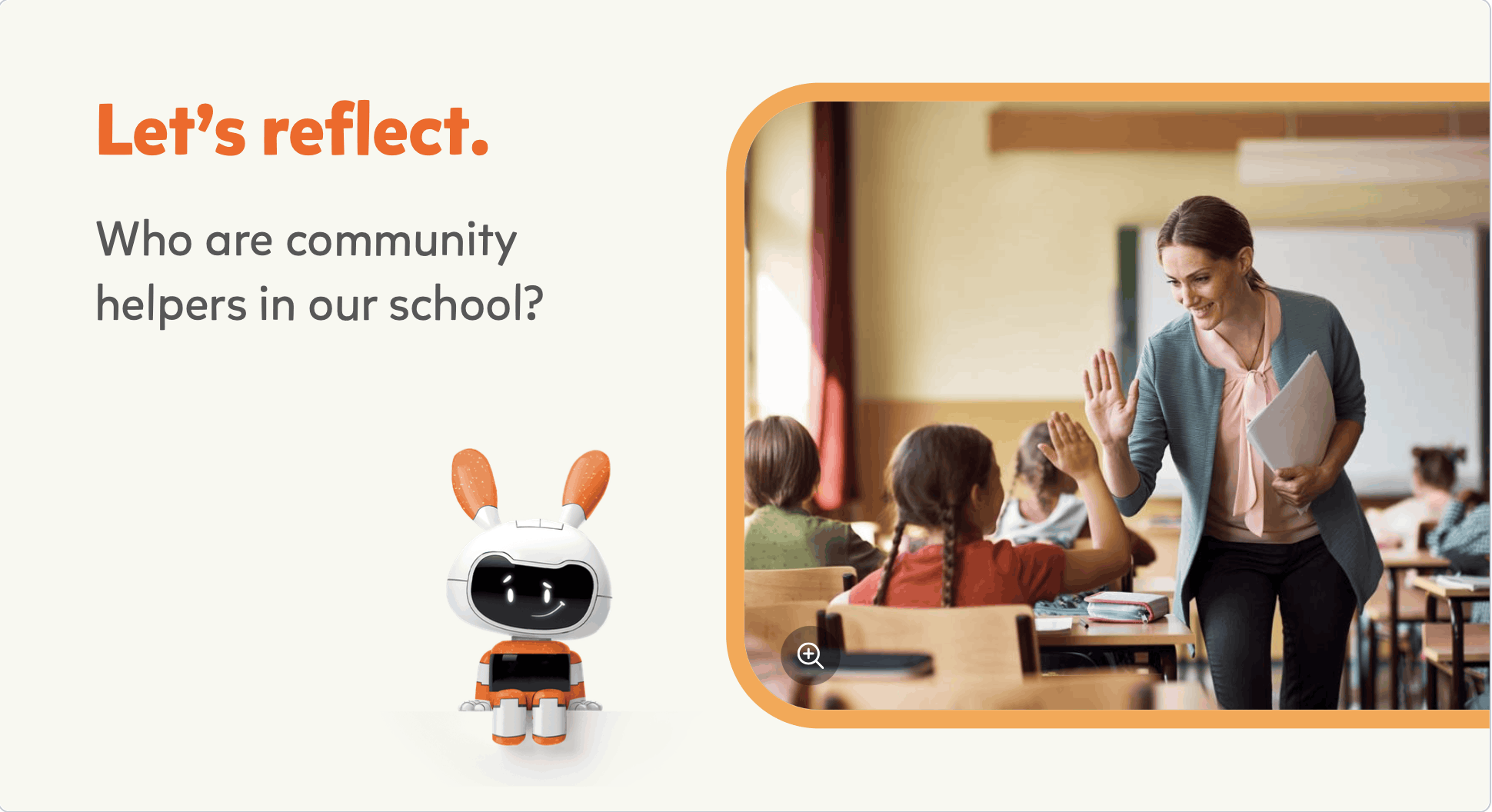
On the slide: Let’s reflect. Who are community helpers in our school?
Suggestions for use
- Read the question to help students make a connection to the video.
- Who are community helpers in our school? Sample response: Teachers, cafeteria workers, crossing guards, and office workers are community helpers at our school.
- Provide time for students to share their responses with the class or a partner.
- Summarize student responses about community helpers at school.
Let’s Try It: Who Are the Community Helpers? (5 minutes)
Use the images on slides 8 to 9 to practice identifying community helpers.
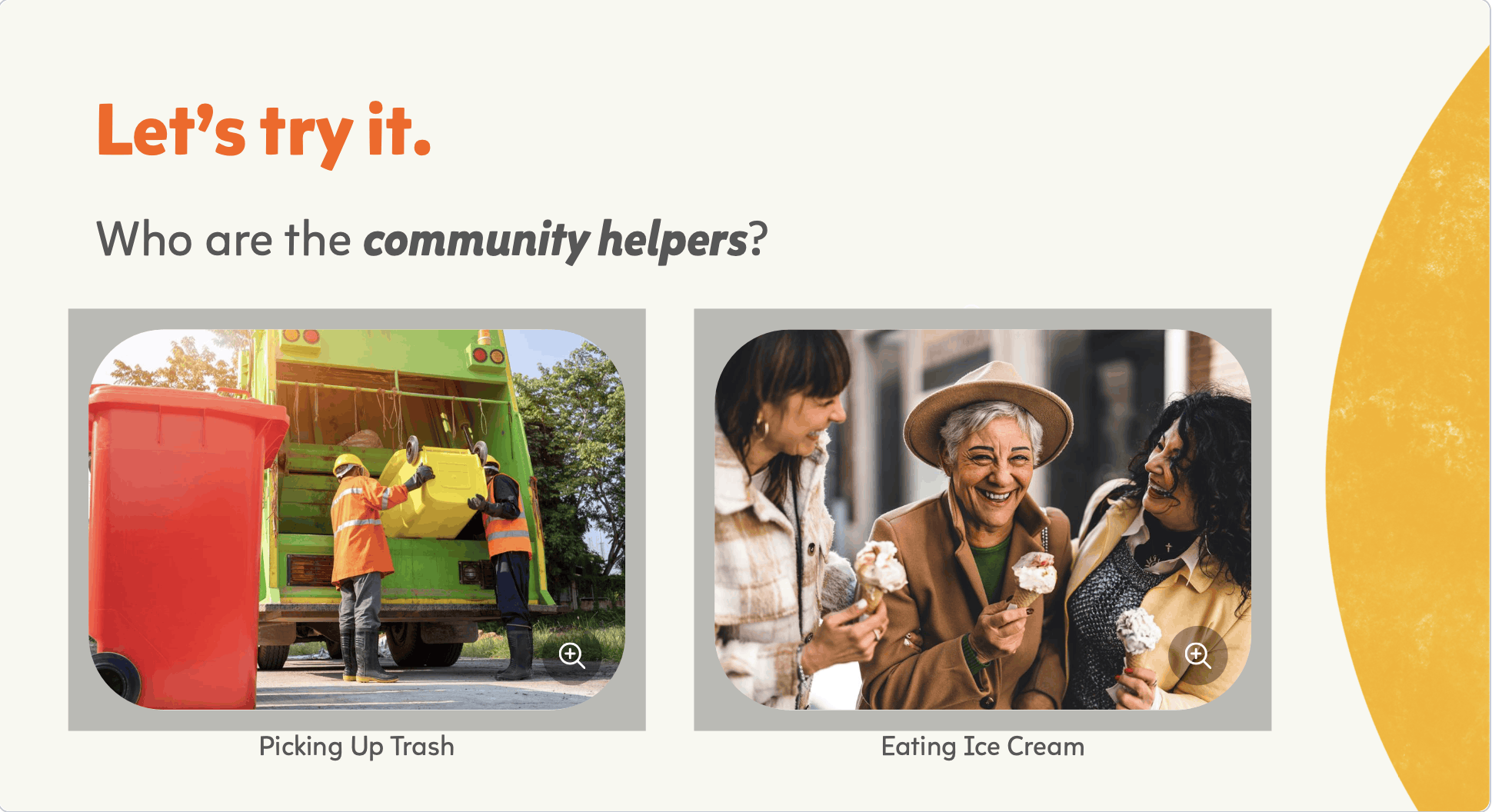
On the slide: Let’s try it. Who are the community helpers? Students look at two images labeled Picking Up Trash and Eating Ice Cream.
Suggestions for use
- Remind students that they have been learning about community helpers.
- Have students look at the images. Select the Zoom icon to provide students with a larger view of each image.
- Prompt students with the following:
- Now, let’s look at the two pictures.
- Are the people picking up trash community helpers? Raise your hand if you think they are community helpers. Sample response: Yes, raise hands.
- Are the people eating ice cream community helpers? Raise your hand if you think they are community helpers. Sample response: No, don’t raise hands.
- Provide time for students to share their responses with the class or a partner.
- Summarize student responses to identify community helpers.
Differentiation
- Students can work with a partner to talk about their observations.
- If students continue to struggle with identifying community helpers, ask the following questions:
- Is someone eating ice cream helping another person? Why? Sample response: No, because they are just having a treat for themselves.
- Where would you see people with a garbage truck? Sample response: I would see a garbage truck on the street, in the town, or in a community.
- Are people who put trash in a truck helping another person? How? Sample response: Yes, they are helping people by making the streets cleaner.
Your Turn: Who Is the Community Helper? (5 minutes)
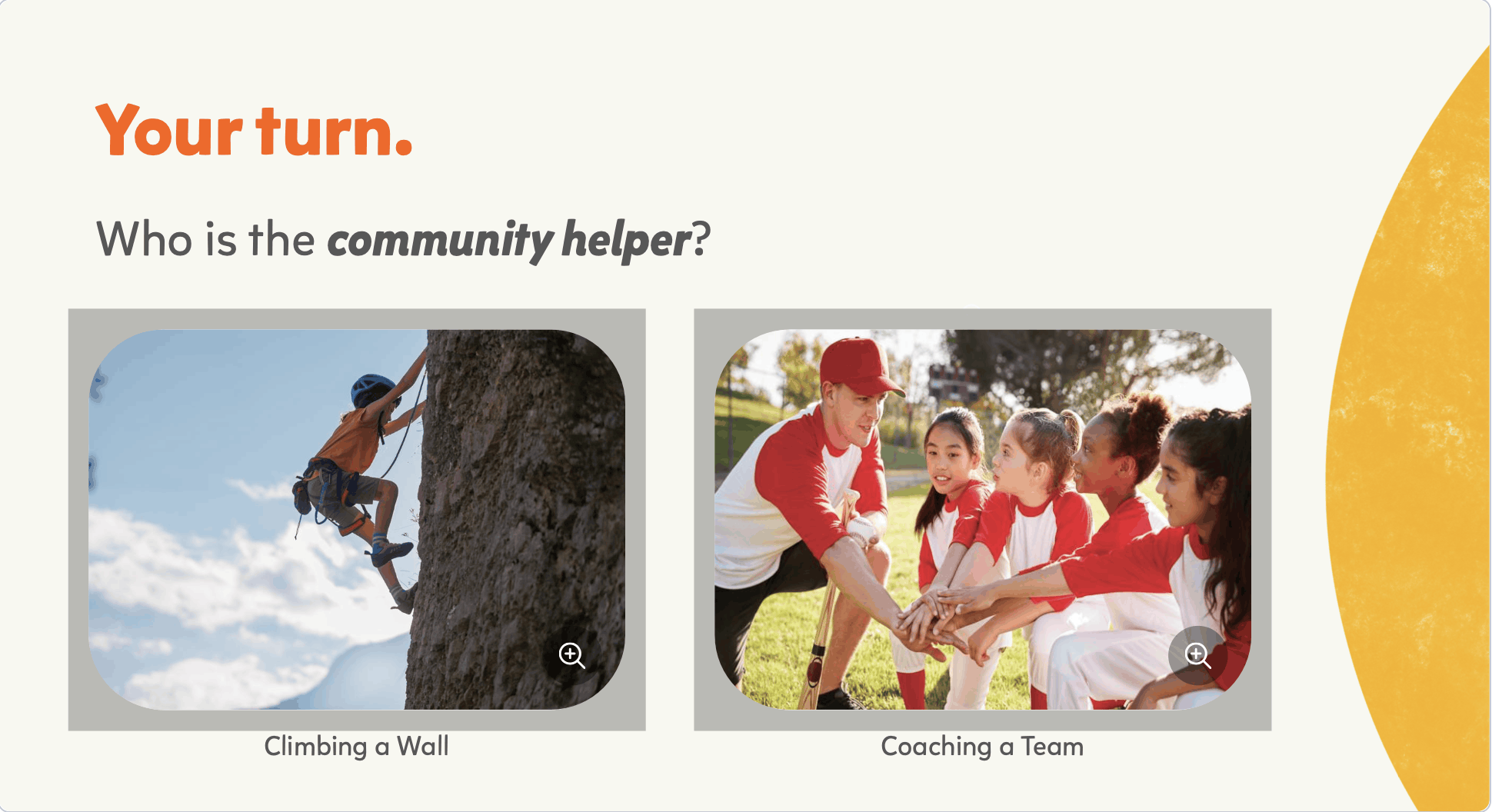
On the slide: Your turn. Who is the community helper? Students look at two images labeled Climbing a Wall and Coaching a Team.
Suggestions for use
- Continue to practice identifying community helpers. Select the Zoom icon to provide students with a larger view of each image.
- Prompt students as follows:
- Think about what you learned about community helpers.
- Now, let’s look at two more pictures.
- Who is the community helper?
- Stand up if you think the mountain climber is a community helper.
- Stand up if you think the coach is a community helper
- Pair up with a partner to discuss your answers.
- Talk with your partners.
- Who is the community helper? Sample response: The coach is the community helper.
- Why is that person a community helper? Sample response: The coach has a job that helps the players.
- Why is the other person not a community helper? Sample response: The climber doesn’t have a job that helps other people.
- Provide time for students to share their responses with the class or a partner.
- Summarize student responses to emphasize how to identify community helpers.
Differentiation
If students continue to struggle with identifying community helpers, ask questions to scaffold their understanding:
- Who helps you every day when you leave your home? Sample response: A teacher or crossing guard helps me.
- What jobs do you see happening in our community? Who does them? Sample response: I see sanitation workers picking up the trash. I see mail carriers delivering the mail.
- What job would you do to be a community helper? Sample response: Answers will vary. Accept all reasonable responses.
Continue the learning: Have students share throughout the week when they hear about community helpers or related vocabulary. For example, students may share when they see specific community helpers such as firefighters or mail carriers.
Way to Go: Celebrate the Learning (2 minutes)
On the slide: Let’s celebrate! Today, we identified community helpers.
Learning target: Today, we will identify community helpers.
Suggestions for use
- Celebrate with your students what they learned today!
- We looked at pictures of community helpers.
- We watched a video about community helpers.
- We practiced what we learned about identifying community helpers.
- We summarized what we learned about community helpers and why they are important.
- Ask students to identify the one thing they are most excited to share with others about community helpers.
Use the lesson assessment as an additional check for understanding.
Key Vocabulary for the Community Helpers Lesson
- community helper: a person who works at a job that helps a community
- job: the work someone does
Timing Modification: Split the Lesson Into Two Sessions
This lesson could be split into two 20-minute sessions:
Part 1: Introduce the lesson using slides 1 to 4, playing the video once.
Part 2: Return to slide 4 to rewatch the video. Then, use slides 5 to 9 to check for understanding.
Helping Students Name the Community Helpers Around Them
Students leave this community helpers lesson plan knowing that a community helper is a person who works at a job that helps a community. By looking closely at pictures, watching a video, and deciding who is and is not a community helper, they practice using that idea in everyday life. Talking and sharing with partners throughout the lesson gives every student a chance to explain their thinking.
Access this and many other social studies lesson plans with a free trial.