Social studies helps students understand history, civics, communities, and the world around them, but fitting it into a busy school day can be challenging. Social Studies Essentials makes it more manageable with curated, standards-aligned resources grounded in the C3 Framework and designed to build literacy, inquiry, and critical-thinking skills. This sample lesson on the three branches of government shows the program’s breadth and depth, with teacher-led instruction, rich content, and opportunities for students to discuss, question, and deepen their understanding.

Preparation
- Access the educator support document to support lesson planning.
- Assess students after the lesson.
Suggestions for use
This is a lesson presentation to support instruction. Use the Present to Class button to view fullscreen.
The lesson moves through five stages:
- Slide 2: Hook students’ interest to learn more about the three branches of the U.S. government.
- Slides 4 to 11: Build knowledge by watching a video and reading text about the three branches of the U.S. government.
- Slide 12: Encourage students to reflect on the three branches of the U.S. government.
- Slide 13: Lead students through an activity that connects to the lesson topic.
- Slide 14: Provide a check for understanding that lets students demonstrate what they learned.
Differentiation
Check for strategy-specific differentiation support in the Teacher Notes throughout this lesson. You can also use Copy & Edit to modify this lesson to further meet your students’ needs.
How to Prepare and Present the Lesson
- Grade: 3
- Total time: 60 minutes (can be split into three 20-minute sessions; see the timing modification below)
- Lesson question: What are the three branches of the U.S. government?
- Learning target: I will identify the three branches of the U.S. government.
Lesson overview: This lesson explores the three branches of the U.S. government. Students will watch a video and read text about the three branches of the U.S. government and apply what they learn to everyday life.
Government can feel abstract to eight- and nine-year-olds. Words like “legislative” and “judicial” are new, and the ideas behind them take time to settle.
This three branches of government lesson plan walks students through one question: What are the three branches of the U.S. government? They watch a video, read text, and apply what they learn to everyday life. Below you will find every step of the lesson, including timing, discussion questions, sample responses, differentiation ideas, and vocabulary.
Access this and many other social studies lesson plans with a free trial.
Three Branches of Government Lesson Plan: Step by Step
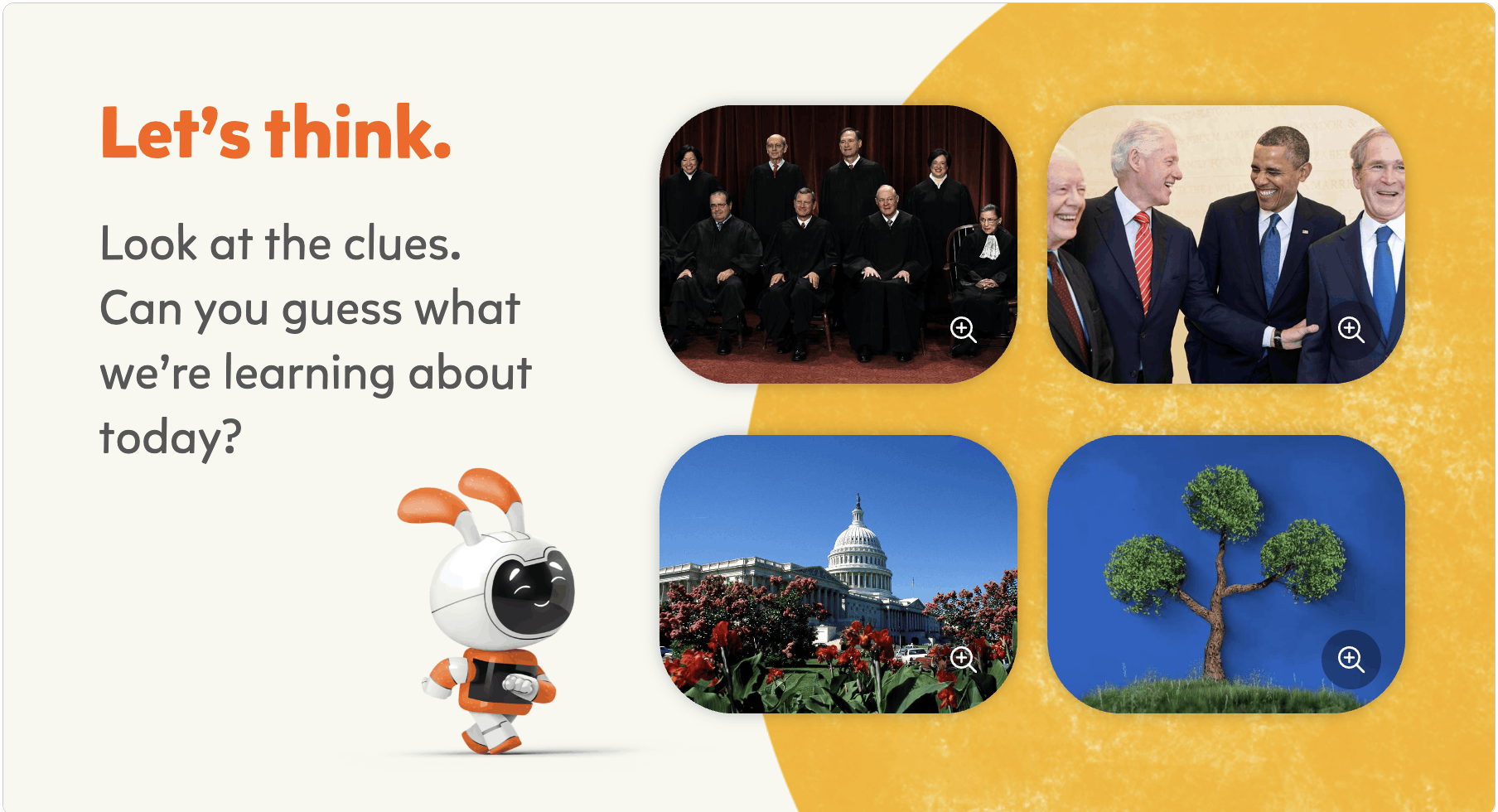
Let’s Think: Hook Students With Can You Guess It? (5 minutes)
Strategy: Can You Guess It?
On the slide: Let’s think. Look at the clues. Can you guess what we’re learning about today?
Suggestions for use
- Use Present to Class with this slide to get students thinking about what they know about the three branches of government.
- Ask students:
- Can you guess what we’re learning about today? Sample response: Answers will vary. Accept all reasonable responses.
- Use the Zoom feature for an even closer look at the images.
- If students need follow-up questions to jumpstart their thinking, consider asking them to make connections among the resources.
- Have students make guesses using the clues.
- Provide time for students to share and explain their thoughts with the class, a small group, or a peer.
- Encourage students to explain the connections between the clues and their guesses.
Differentiation
- Provide a series of guiding questions to help students focus on specific details within the images.
- Students can work with a partner to talk about their observations.
Hook strategy support: This hook strategy was inspired by the instructional strategy Collage. Refer to the Collage strategy guide for additional support.
Learning Target (3 minutes)
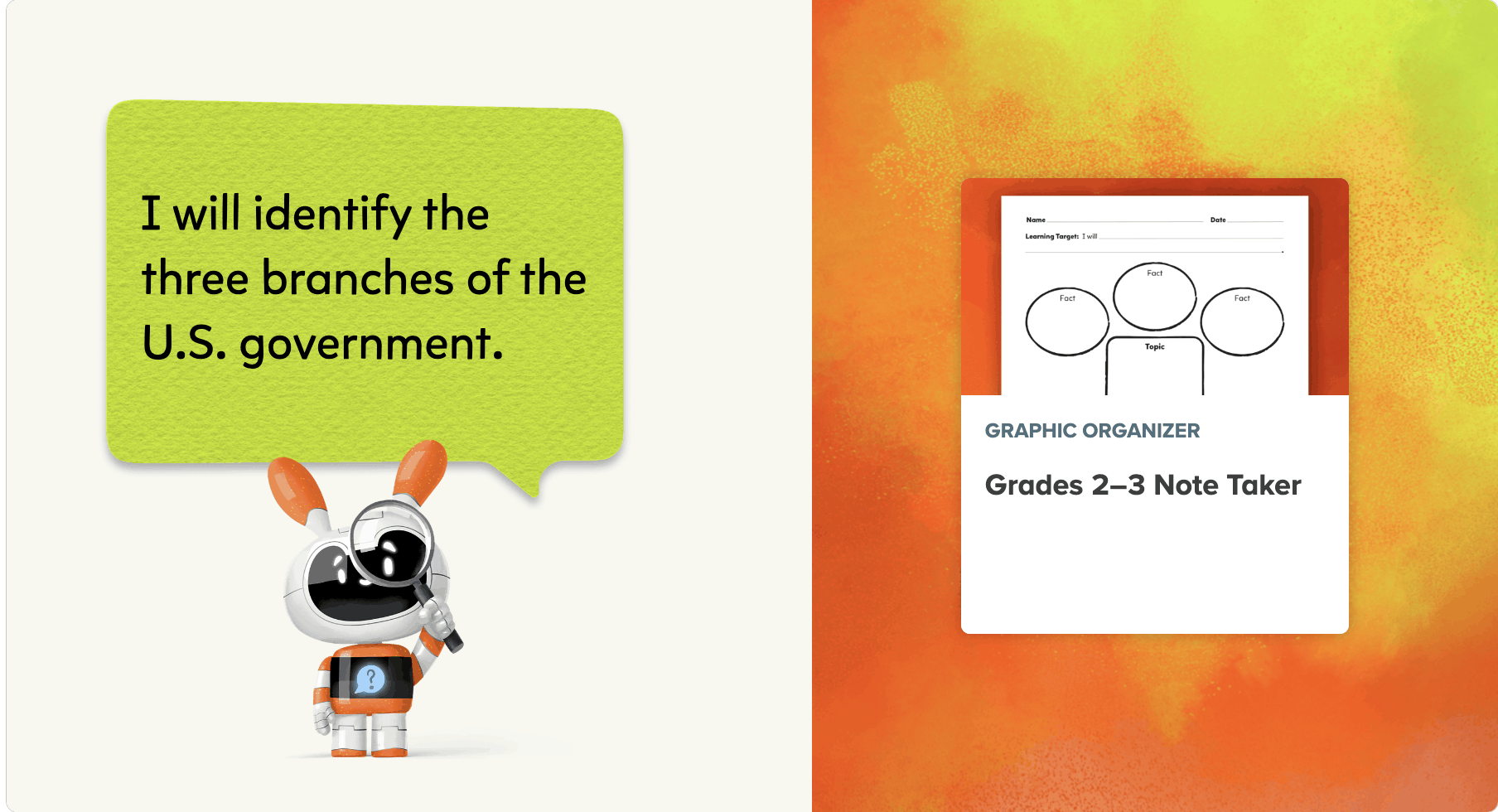
On the slide: I will identify the three branches of the U.S. government. A Grades 2 to 3 Note Taker graphic organizer appears next to it.
Learning target: I will identify the three branches of the U.S. government.
Suggestions for use
Provide students with support to capture their thinking throughout their learning.
- Print the graphic organizer.
- Ask students to record the Learning Target.
- Prompt students to take notes and generate questions throughout their learning.
Watch to Learn (8 minutes)
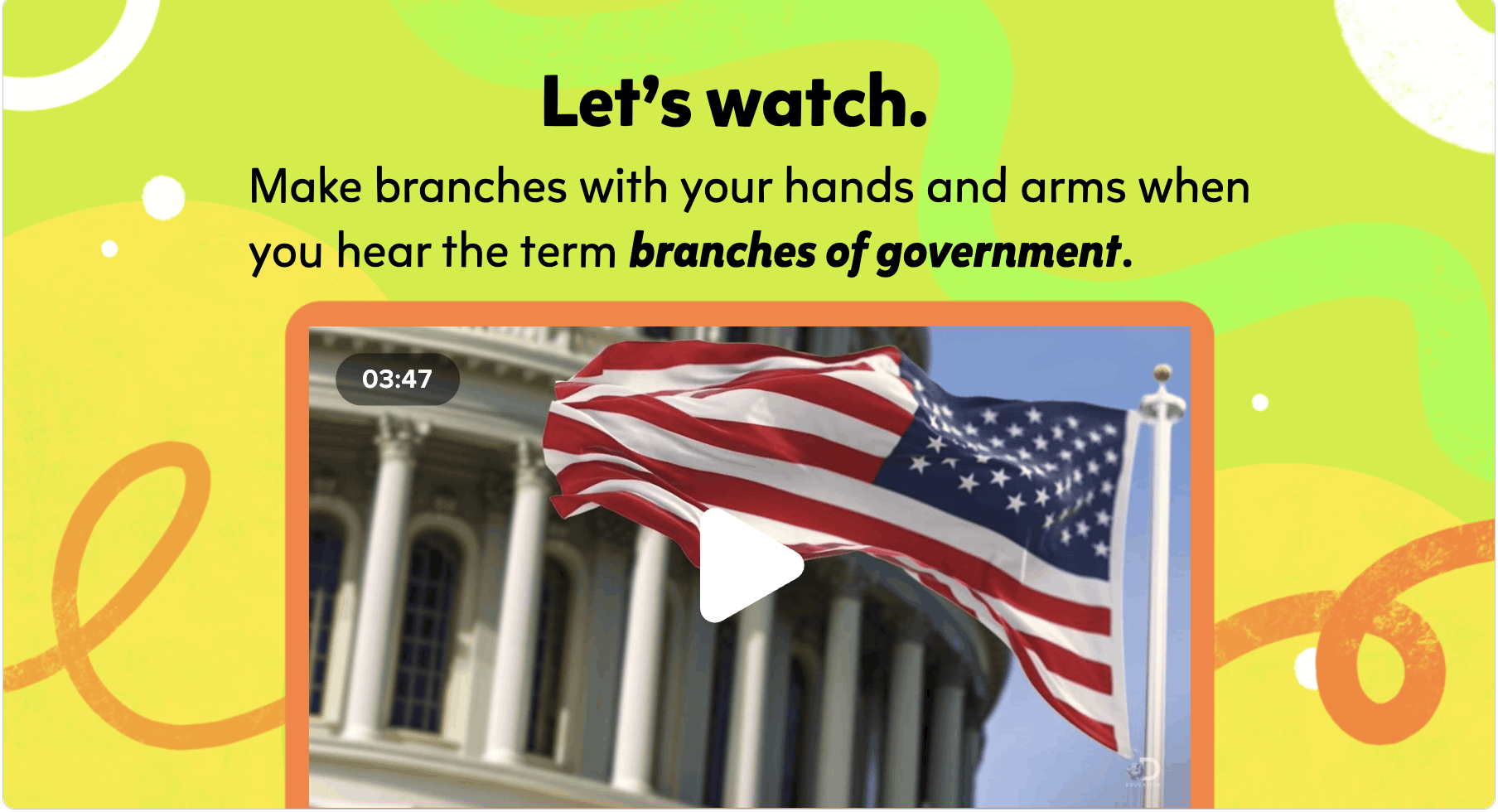
Use this video to learn about the three branches of the U.S. government.
On the slide: Let’s watch. Make branches with your hands and arms when you hear the term branches of government.
Suggestions for use
- Ask students to make branches with their hands and arms when they hear the term branches of government.
- After playing the video, provide time for students to discuss what they saw and heard. Consider asking students these questions:
- What is the main idea of the video about the federal government? Include one supporting detail. Sample response: The main idea of the video is that the U.S. federal government is divided into three branches that work together to run the country and keep power balanced. One supporting detail is that the legislative branch makes laws, the executive branch carries out laws, and the judicial branch interprets laws.
- What are the three branches called? Sample response: The three branches are the Legislative Branch, the Executive Branch, and the Judicial Branch.
- What system helps keep the branches from having too much power? Sample response: Checks and balances help keep the branches balanced.
- Check for students’ understanding of the meaning of:
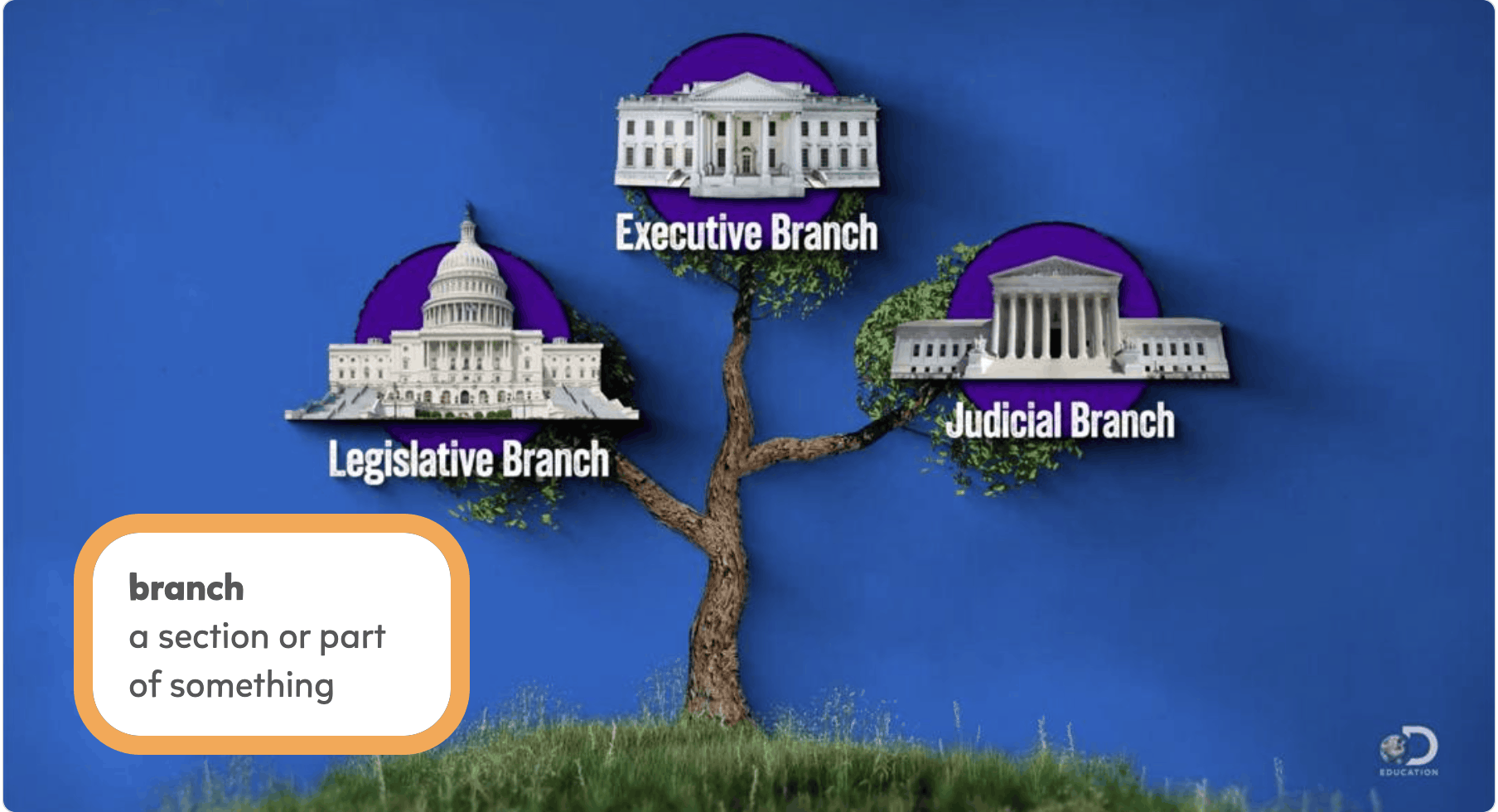
- branch: a section or part of something
- Summarize student responses about the three branches of the U.S. government.
- If time permits, play the video again for students, pausing as needed and letting them comment on anything new they learned.
- Use the images and text on slide 5 to support students’ vocabulary development.
Differentiation
- Students’ observations can be shared through partner, small-group, or class discussions.
- Ask questions to scaffold students’ observations:
- What do you see in the video? Sample response: I see people talking about the government.
- What words did you hear that are important? Sample response: I heard three branches and checks and balances.
Lesson Vocabulary (5 minutes)
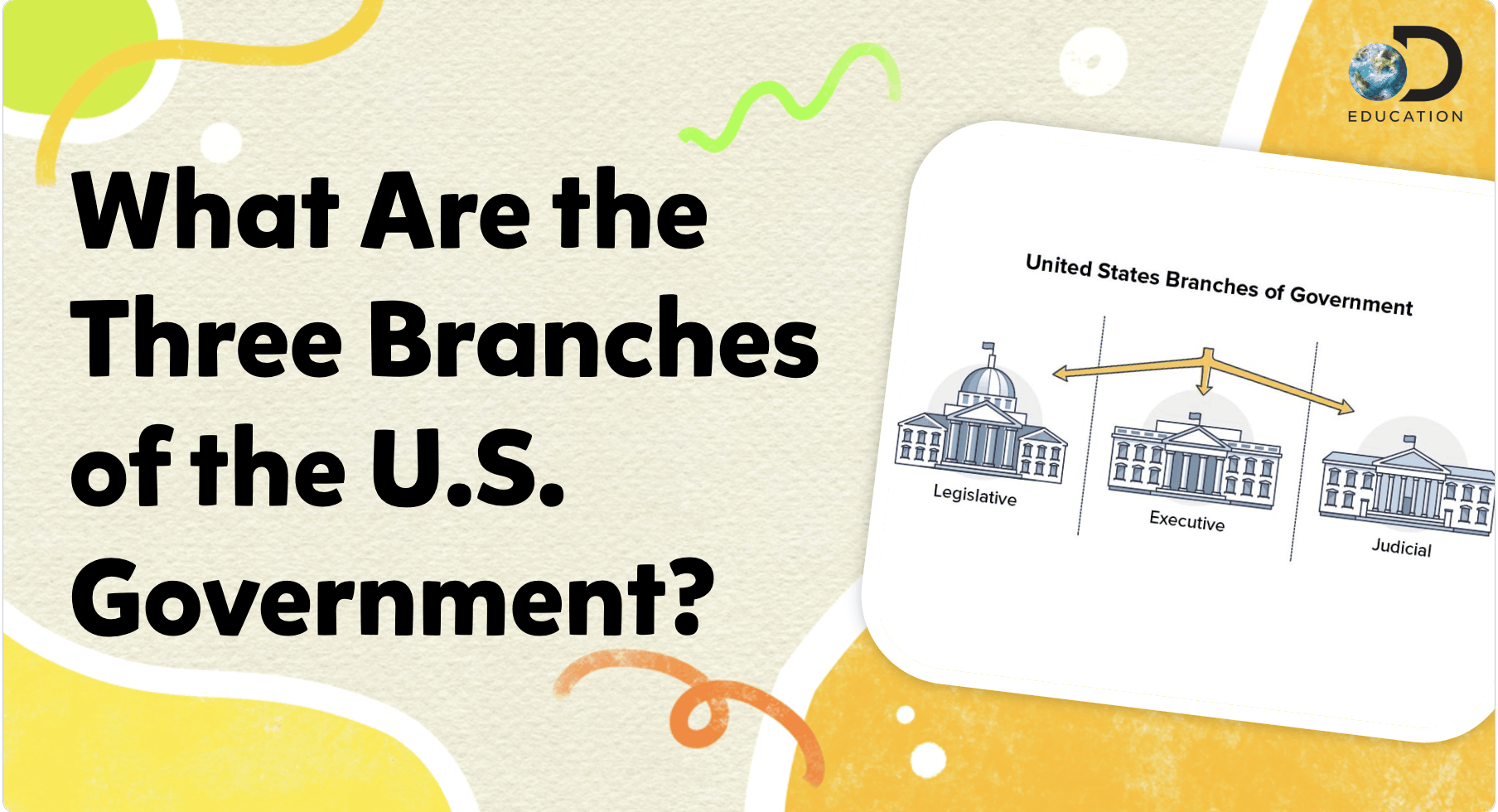
Use this slide to reinforce students’ understanding of the term branch.
On the slide: branch: a section or part of something.
Suggestions for use
- Have students look at the image. Ask:
- What do you notice? Sample response: I notice there are three parts shown.
- Read the text with your class. Ask:
- What does the word branch mean in this lesson? Sample response: A branch means a section or part of the government.
- How many branches are in the U.S. government? Sample response: There are three branches.
- Can you name one branch of the government? Sample response: One branch is the Legislative Branch.
Differentiation
Ask questions to scaffold students’ observations:
- What do you see in the picture? Sample response: I see three sections.
- What do all three sections belong to? Sample response: They all belong to the government.
- Are the branches the same or different? Sample response: They are different parts of the government.
- Why do you think the government is divided into branches? Sample response: So different parts of the government can do different jobs.
Let’s Think: Why Three Branches? (2 minutes)
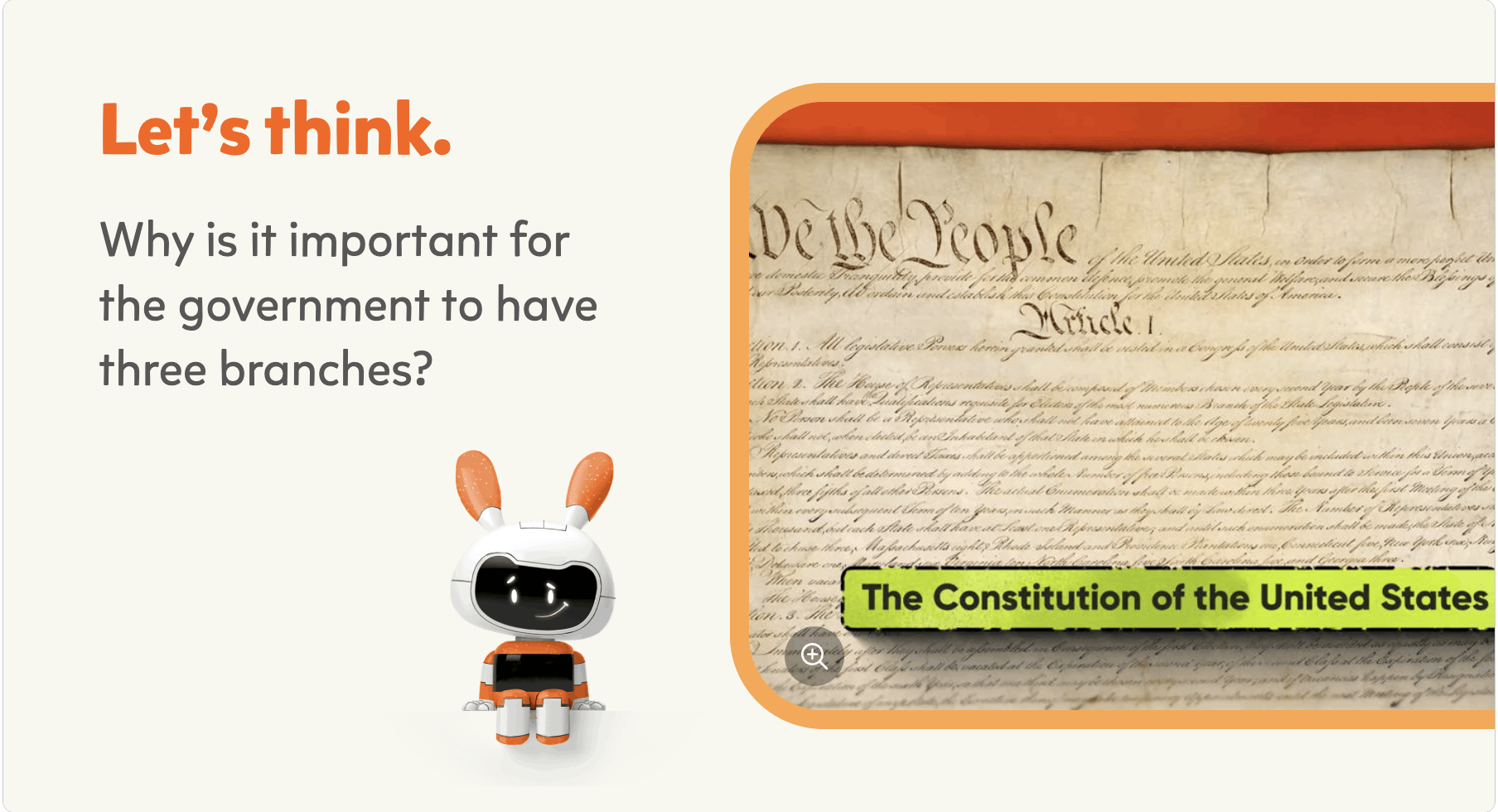
On the slide: Let’s think. Why is it important for the government to have three branches?
Suggestions for use
- Read the question to help students think about fairness and balance in the government.
- Why is it important for the government to have three branches? Sample response: It is important so no one gets too much power and things stay fair.
- Provide time for students to share their responses with the class or a partner.
- Summarize student responses about the three branches of government.
Let’s Explore (2 minutes)
Use the text on slides 8 to 12 to introduce the three branches of the U.S. government.
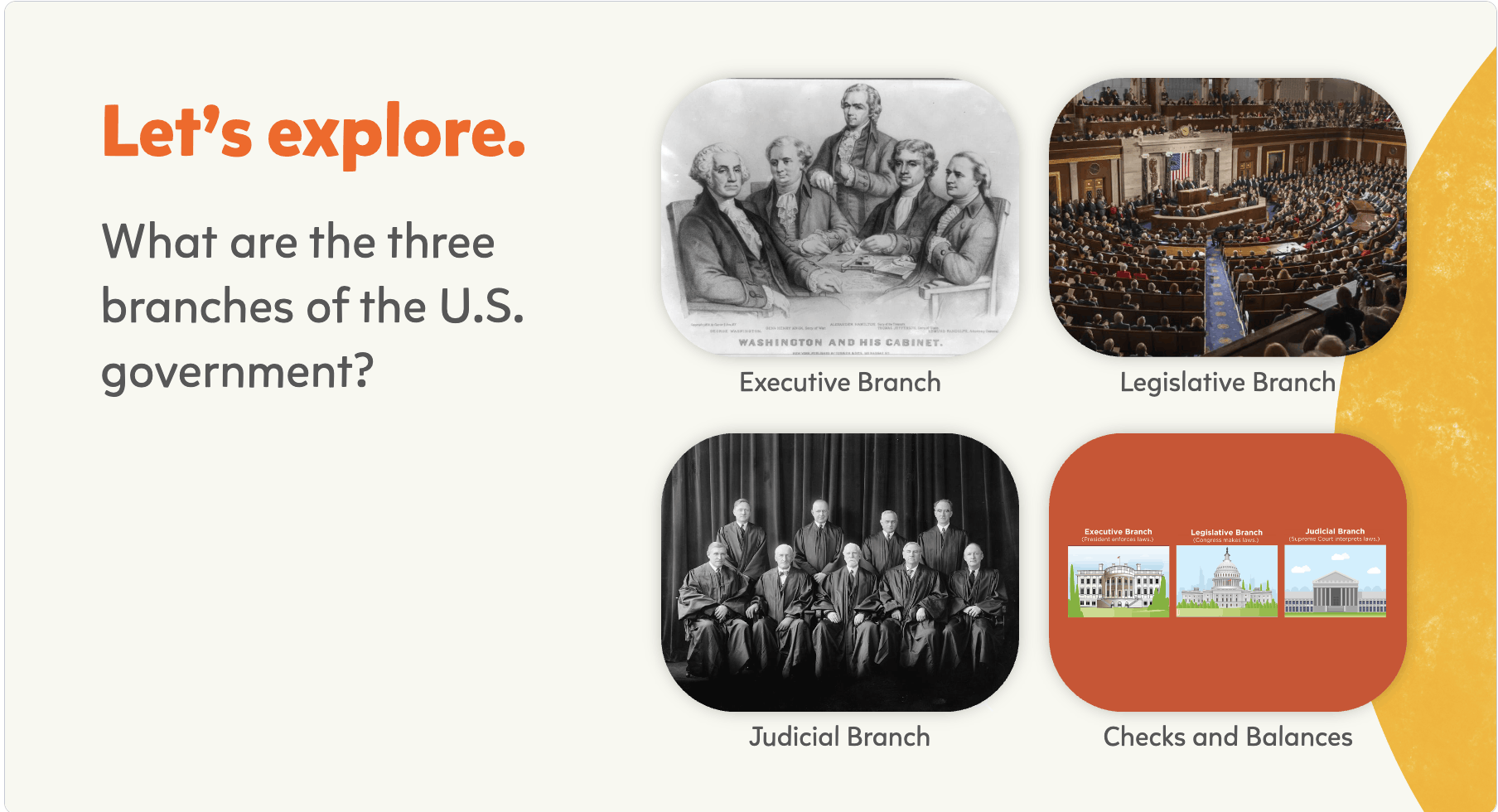
On the slide: Let’s explore. What are the three branches of the U.S. government? Students choose from four images: Executive Branch, Legislative Branch, Judicial Branch, and Checks and Balances.
Suggestions for use
- Select an image to read about the three branches of the U.S. government.
- Read the text aloud to students.
- Pause to provide clarification or ask questions while reading.
- After each reading, support students with the tasks on each slide. These may include drawing, writing, discussing, or acting out a scenario. Students can write and draw on loose paper or in notebooks to capture their thinking.
Differentiation
- Have students partner up to read the descriptions of each example of the three branches of the U.S. government.
- Print each slide. Then, divide students into groups to learn about the three branches of the U.S. government. Have groups share with the class.
Explore Topic 1: The Executive Branch (5 minutes)
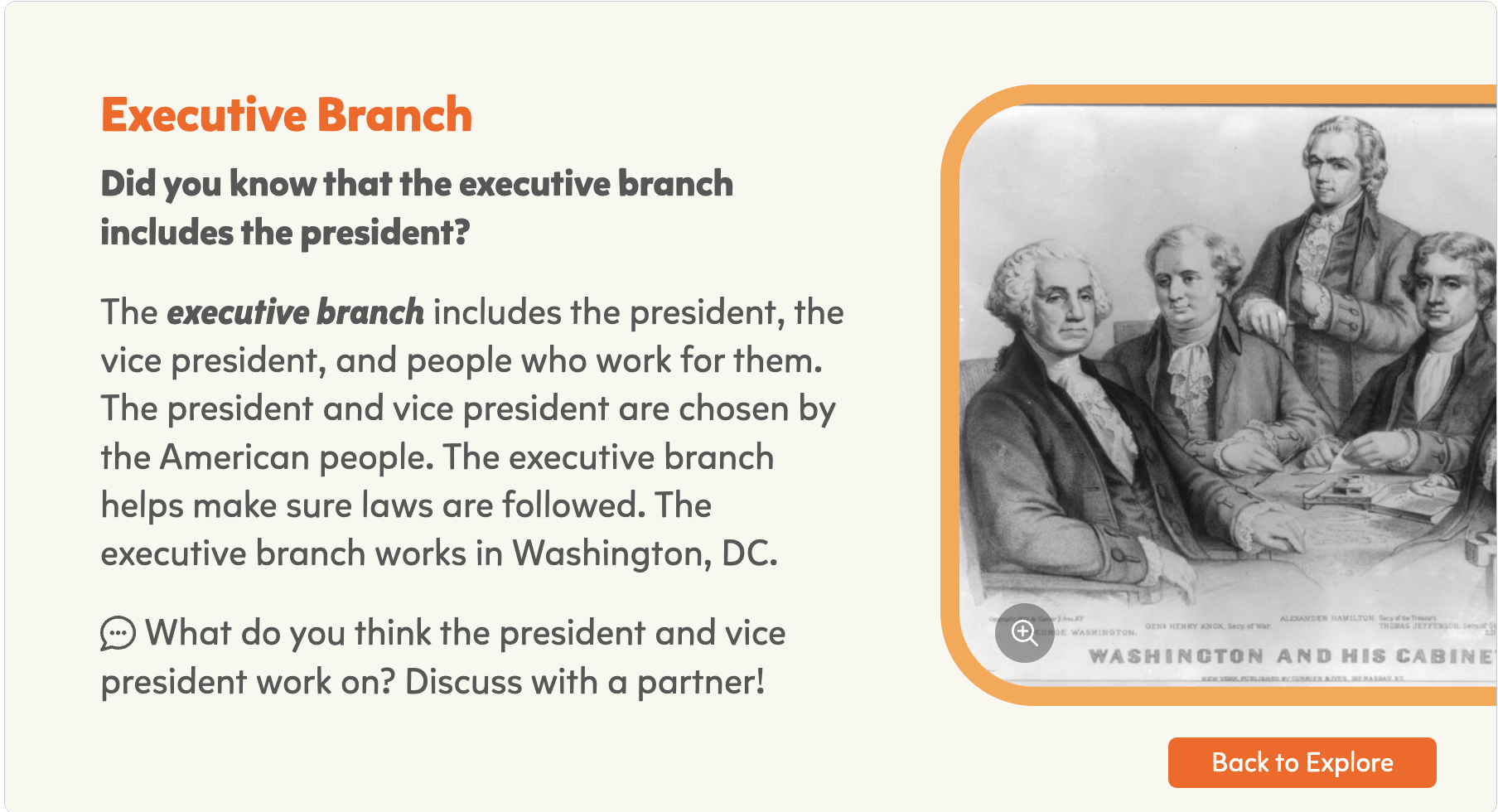
On the slide: Executive Branch. Did you know that the executive branch includes the president? The executive branch includes the president, the vice president, and people who work for them. The president and vice president are chosen by the American people. The executive branch helps make sure laws are followed. The executive branch works in Washington, DC. Students are then asked: What do you think the president and vice president work on? Discuss with a partner!
Suggestions for use
- Read the text aloud to students.
- Pause to provide clarification or ask questions while reading.
- Provide time for students to discuss the executive branch.
- After reading, check for students’ understanding of the meaning of:
- executive branch: the part of the government that includes the president and helps carry out the laws
- Students will discuss with their partner what they think the president and vice president work on.
- Return to explore more about the three branches of the U.S. government by using the Back to Explore button.
Differentiation
- Use the Immersive Reader functionality to have words read aloud, enlarge the text, and create line-by-line focus.
- If students struggle with understanding the executive branch, ask questions to help illustrate the importance of the president’s role in the executive branch:
- Who is part of the executive branch? Sample response: The president, vice president, and the people who work for them.
- How is the president chosen? Sample response: People vote and the person with the most votes is elected as president.
- Where does the executive branch work? Sample response: They work in Washington, DC.
Explore Topic 2: The Legislative Branch (5 minutes)
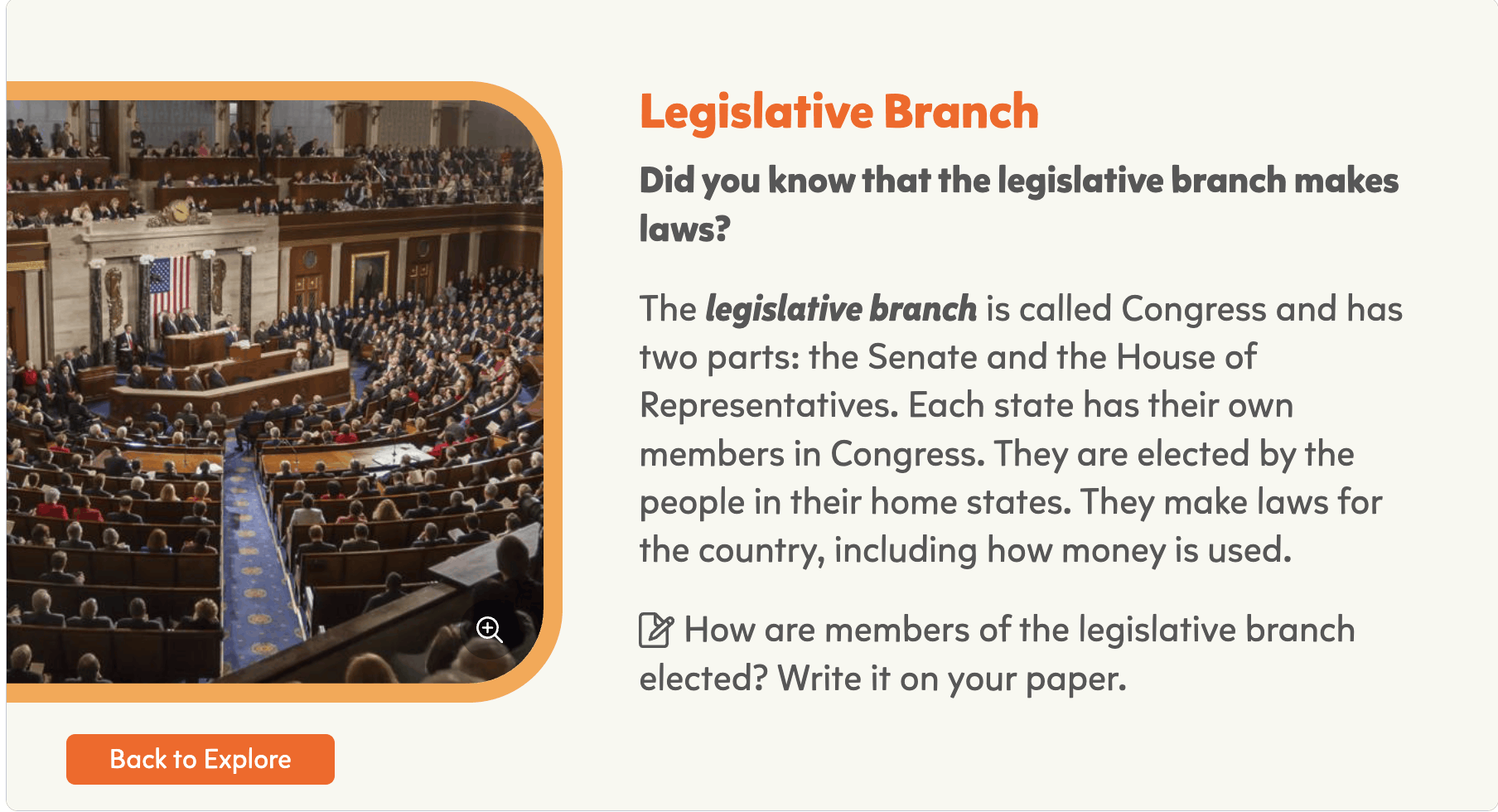
On the slide: Legislative Branch. Did you know that the legislative branch makes laws? The legislative branch is called Congress and has two parts: the Senate and the House of Representatives. Each state has their own members in Congress. They are elected by the people in their home states. They make laws for the country, including how money is used. Students are then asked: How are members of the legislative branch elected? Write it on your paper.
Suggestions for use
- Read the text aloud to students.
- Pause to provide clarification or ask questions while reading.
- Provide time for students to discuss the legislative branch.
- After reading, check for students’ understanding of the meaning of:
- legislative branch: the part of the government that includes Congress and makes the laws
- Students will write about how legislative branch members are elected.
- Return to explore more about the three branches of the U.S. government by using the Back to Explore button.
Differentiation
- Use the Immersive Reader functionality to have words read aloud, enlarge the text, and create line-by-line focus.
- If students struggle with understanding the legislative branch, ask questions to help illustrate the importance of the role of the members of Congress:
- What is Congress? Sample response: Congress is the legislative branch. It is made of two parts: the House of Representatives and the Senate.
- What does Congress do? Sample response: Congress makes laws.
- Who chooses the people in the Congress? Sample response: People in each state vote for their members of Congress.
Explore Topic 3: The Judicial Branch (5 minutes)
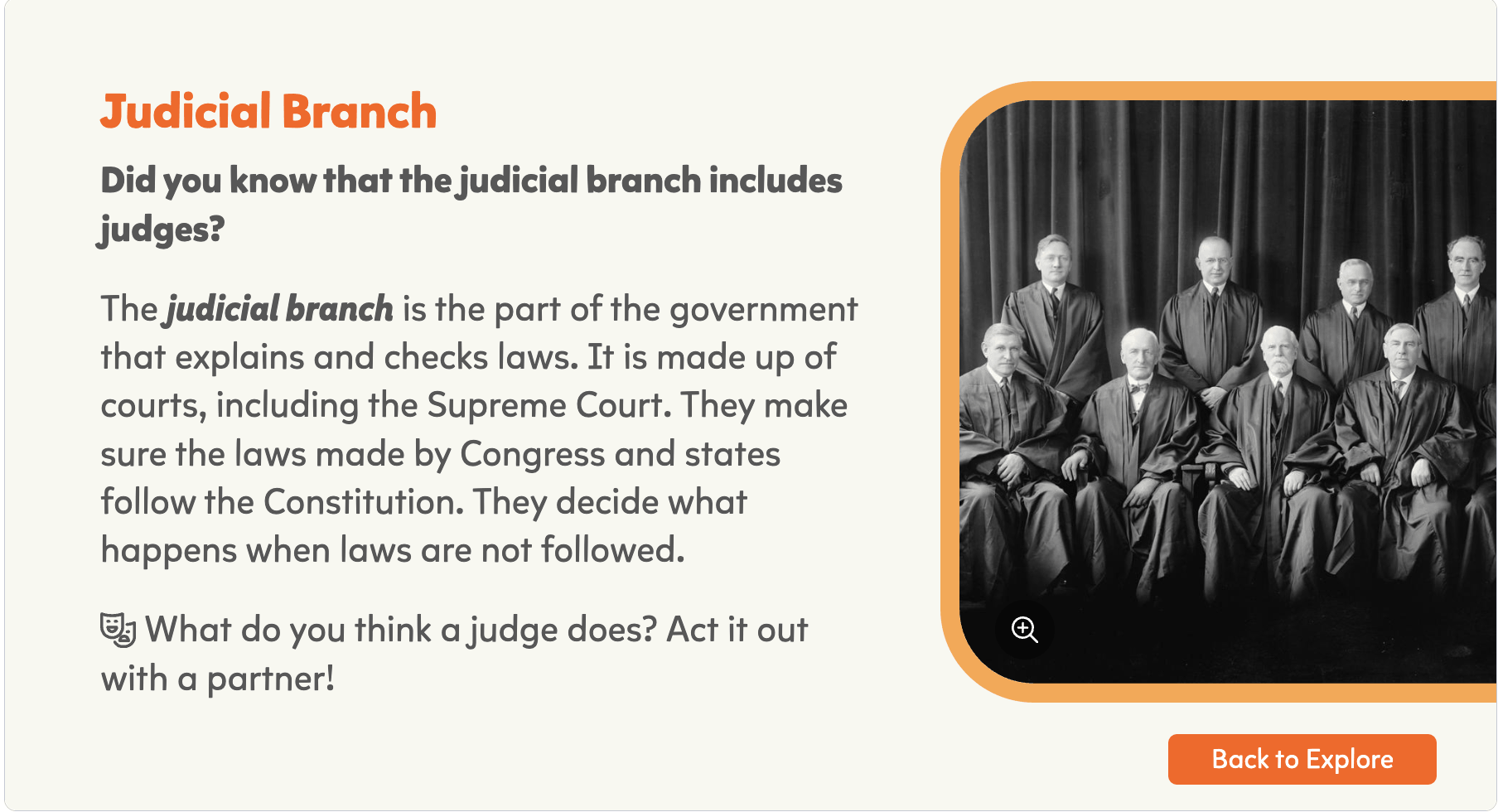
On the slide: Judicial Branch. Did you know that the judicial branch includes judges? The judicial branch is the part of the government that explains and checks laws. It is made up of courts, including the Supreme Court. They make sure the laws made by Congress and states follow the Constitution. They decide what happens when laws are not followed. Students are then asked: What do you think a judge does? Act it out with a partner!
Suggestions for use
- Read the text aloud to students.
- Pause to provide clarification or ask questions while reading.
- Provide time for students to discuss the judicial branch.
- After reading, check for students’ understanding of the meaning of:
- judicial branch: the part of the government that includes the court system that makes sure laws follow the Constitution
- Students will act out what they think a judge does.
- Return to explore more about the three branches of the U.S. government by using the Back to Explore button.
Differentiation
- Use the Immersive Reader functionality to have words read aloud, enlarge the text, and create line-by-line focus.
- If students struggle with understanding the judicial branch, ask questions to help illustrate the importance of following the law:
- Who is part of the judicial branch? Sample response: Judges and the court system are part of the judicial branch.
- What do judges do with laws? Sample response: They make sure that people are following the laws and that the laws follow the Constitution.
- What do you think would happen if laws did not follow the Constitution? Sample response: People might be treated unfairly or states might have conflicting laws.
Explore Topic 4: Checks and Balances (5 minutes)
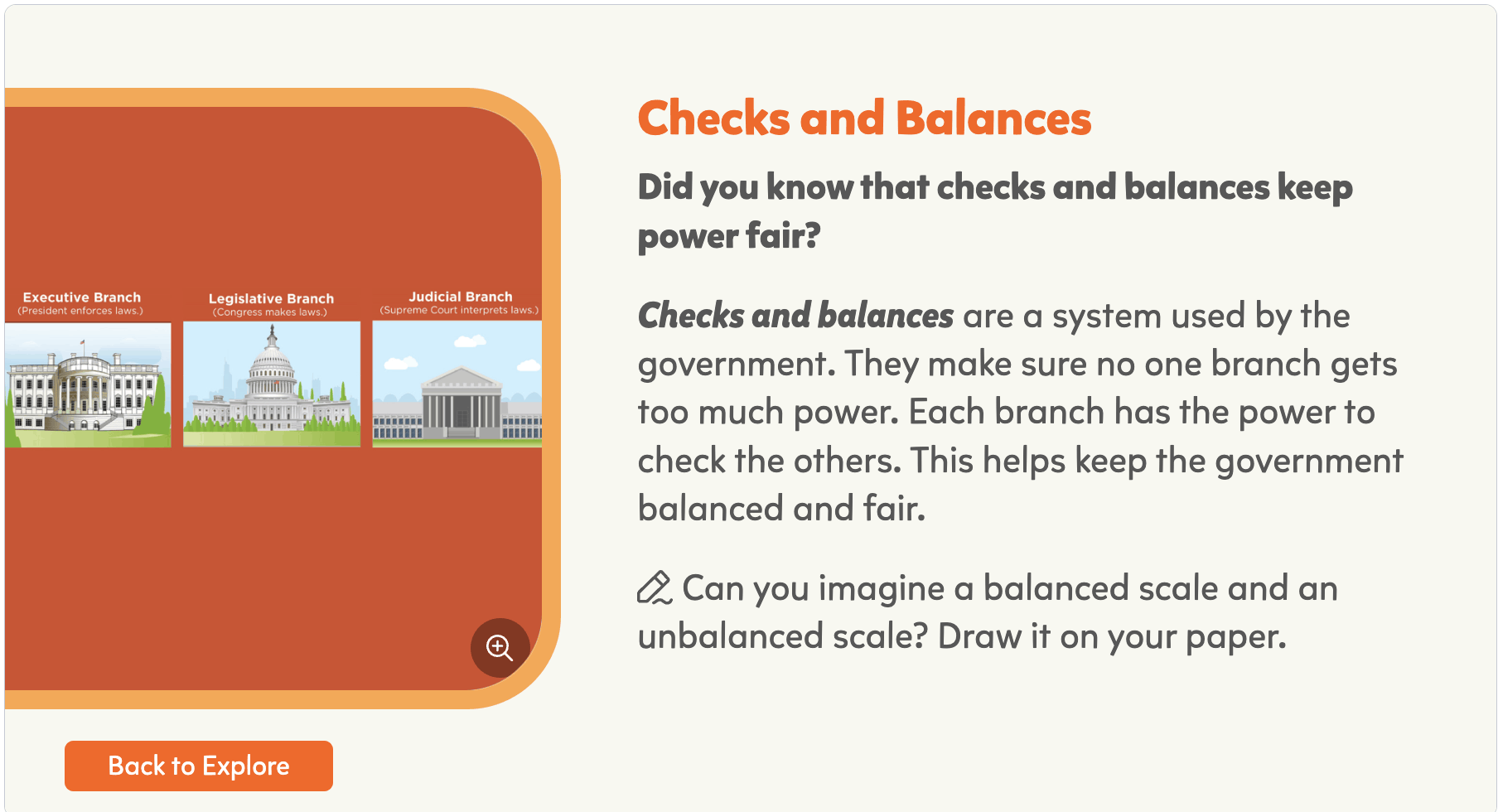
On the slide: Checks and Balances. Did you know that checks and balances keep power fair? Checks and balances are a system used by the government. They make sure no one branch gets too much power. Each branch has the power to check the others. This helps keep the government balanced and fair. Students are then asked: Can you imagine a balanced scale and an unbalanced scale? Draw it on your paper.
Suggestions for use
- Read the text aloud to students.
- Pause to provide clarification or ask questions while reading.
- Provide time for students to discuss checks and balances.
- After reading, check for students’ understanding of the meaning of:
- checks and balances: a system that makes sure different parts of the government work together fairly and no one gets too much power
- Students will draw a picture of a balanced scale and an unbalanced scale.
- Return to explore more about the three branches of the U.S. government by using the Back to Explore button.
Differentiation
- Use the Immersive Reader functionality to have words read aloud, enlarge the text, and create line-by-line focus.
- If students struggle with understanding checks and balances, ask questions to help illustrate the importance of balancing power:
- Why is balance important? Sample response: So things are fair.
- What happens if one branch has too much power? Sample response: It would not be fair.
- What do checks and balances help do? Sample response: Keep power balanced.
Reflection (3 minutes)
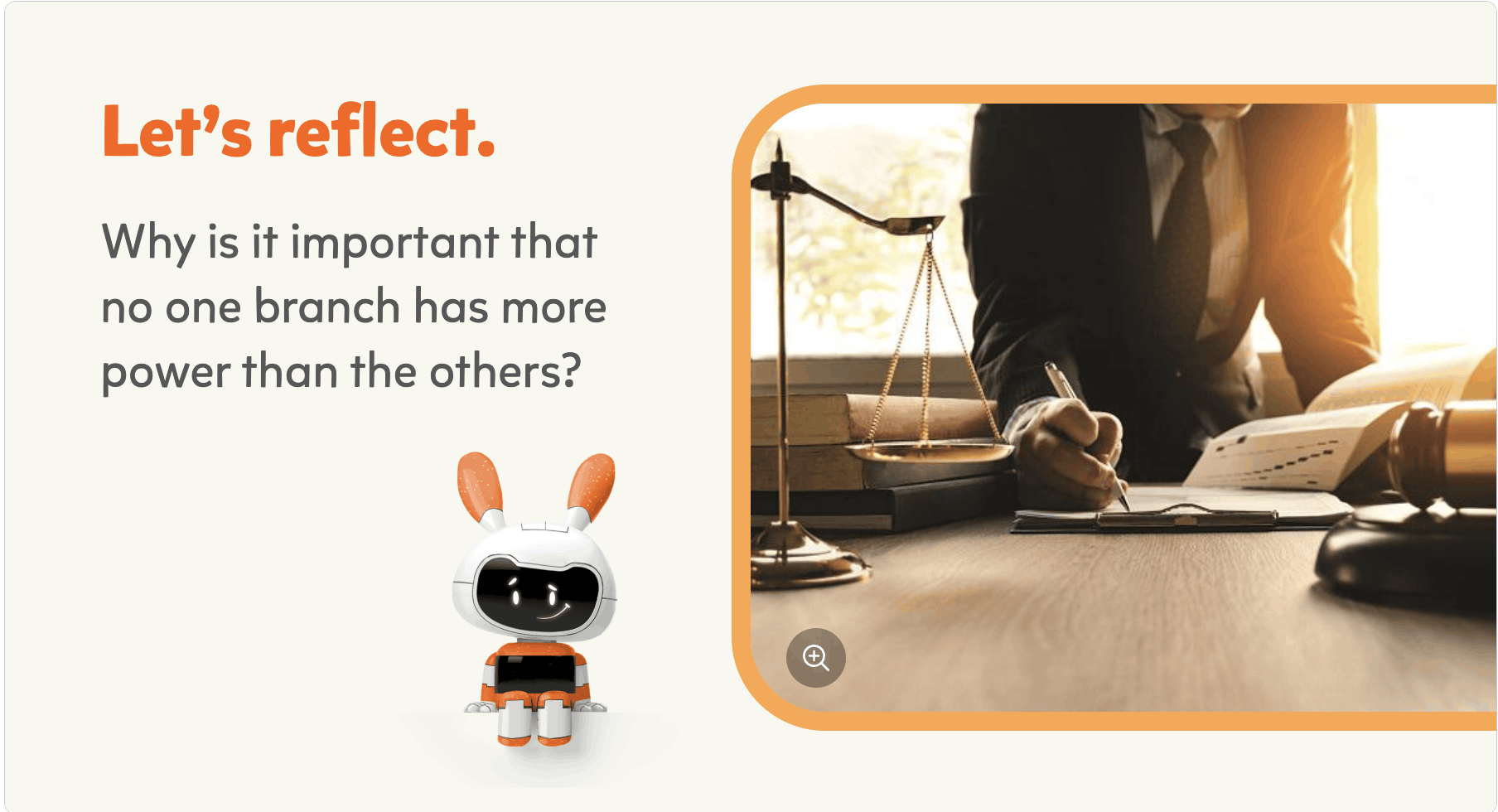
On the slide: Let’s reflect. Why is it important that no one branch has more power than the others?
Suggestions for use
- Read the question to help students think about fairness and balance in the government.
- Why is it important that no one branch has more power than the others? Sample response: It is important so things stay fair and one branch does not take over.
- Provide time for students to share their responses with the class or a partner.
- Summarize student responses about the three branches of government.
Let’s Try It: ABC Summary (5 minutes)
Strategy: ABC Summary
On the slide: Let’s try it. What did we learn about the three branches of government? The four images (Executive Branch, Legislative Branch, Judicial Branch, and Checks and Balances) appear again.
Suggestions for use
- Have students share their observations about the three branches of government using one of the letters.
- Encourage students to try using different letters.
- Remind students that the United States government is made up of three separate branches.
- Provide time for students to share their responses with the class.
Differentiation
- If students continue to struggle with the three branches of government, ask the following questions:
- How many branches are in the U.S. government? Sample response: There are three branches.
- Can you name one branch of the government? Sample response: One branch is the Executive Branch.
- Why is it important that the branches share power? Sample response: So no one branch has too much power.
Your Turn: Write an ABC Summary (5 minutes)
On the slide: Your turn. 1. Choose a letter from the alphabet. 2. What did you learn about the three branches of government today? 3. Write a sentence about something you learned. Begin your sentence with the letter you chose.
Suggestions for use
- Have students use their observations to create an ABC Summary about the three branches of government.
- It’s not necessary for all letters to be used or for each student to use a different letter.
- Students can use a journal or sheet of paper to capture their thinking.
- Have students find a partner so they can share their ABC Summary sentences. Give them 3 to 4 minutes to share why they chose that letter and discuss what they learned. Use a signal to indicate when it’s time to find a different partner.
Differentiation
- Assign letters to students based on ability. Some letters will be easier, such as: A, M, S, and T. Some letters will be more difficult, such as: Q, W, X, Y, and Z.
- For students who may be challenged to come up with a sentence, have them write a word or phrase or draw a picture that starts with their chosen letter.
- Some students may write multiple sentences or choose a less-frequently used letter as a challenge.
- Compile a class ABC Summary by combining individual student summaries in alphabetical order.
- Students can share their observations with a partner or small group.
- Review the ABC Summary resource for an overview of the strategy and to consider potential extensions or modifications to tailor the activity to learners’ needs.
- Share the ABC Summary for Students video, if needed, to help them understand the task.
Way to Go: Celebrate the Learning (2 minutes)
On the slide: Way to go! Today we identified the three branches of the U.S. government.
Learning target: I will identify the three branches of the U.S. government.
Suggestions for use
- Celebrate with your students what they learned today!
- We looked at images related to the three branches of government and checks and balances.
- We read text about the executive, legislative, and judicial branches.
- We practiced naming and identifying the three branches of government.
- We summarized what each branch is and how they share power.
- Ask students to identify the one thing they are most excited to share with others about the three branches of government.
Use the lesson assessment as an additional check for understanding.
Key Vocabulary for the Three Branches of Government
- branch: a section or part of something
- checks and balances: a system that makes sure different parts of the government work together fairly and no one gets too much power
- executive branch: the part of the government that includes the president and helps carry out the laws
- judicial branch: the part of the government that includes the court system that makes sure laws follow the Constitution
- legislative branch: the part of the government that includes Congress and makes the laws
Timing Modification: Split the Lesson Into Three Sessions
This lesson could be split into three 20-minute sessions:
Part 1: Introduce the lesson using slides 1 to 3. Then, use slide 4 to watch a video and read a vocabulary word related to the three branches of the U.S. government. Use slide 5 to review vocabulary. Use slide 6 to engage students with a reflection question.
Part 2: Use slides 7 to 11 to explore and learn about the three branches of the U.S. government. Use slide 12 to engage students with a reflection question.
Part 3: Use slide 13 to lead students through a whole-group activity. Then use slide 14 to provide a check for understanding.
Helping Students Remember the Three Branches
Students leave this three branches of government lesson plan with more than three vocabulary words. They understand that government is divided into parts that share power so that things stay fair. Pairing movement, talk, writing, drawing, and acting helps the idea stick for different kinds of learners.
Access this and many other social studies lesson plans with a free trial.