Key takeaways
-
The 5 strands of social studies — history, geography, civics and government, economics, and culture give teachers a clear, organized way to structure an inherently interdisciplinary subject.
-
Each strand addresses a different kind of question about how societies work, and together they build a fuller picture than any single discipline could on its own.
-
The 5 strands of social studies show up across grade levels in different forms, from simple community concepts in early elementary to complex policy analysis in high school.
Social studies has always been a diverse subject, pulling together history, geography, government, economics, and culture into a single discipline meant to help students understand how societies function and how they got that way. It is difficult to fully grasp the historical context without all 5 of these strands. That breadth is exactly what makes social studies valuable and exactly what makes it hard to teach coherently without some kind of organizing structure. This structure helps teachers address complex topics without letting context fall through the gaps.
The five strands of social studies are one solution to the above problem. Rather than looking at social studies in its holistic form, the five strands examine it through different lenses and provide a teacher with a lesson template, while allowing a student to have an idea of the questions they can ask whenever a new topic is introduced. This is part of the growing trend in social studies education, where learning is organized by discipline rather than along a linear timeline. The five strands have become one of the most popular frameworks in use in K-12 classes, especially at the elementary level. In elementary school, the majority of the curriculum is brand new and, without organization, can be overwhelming.
What Are the 5 Strands of Social Studies?
History
History is the study of past events, people, and decisions, and how they connect to shape the present. In the classroom, history asks students to examine cause and effect over time, why a decision was made, what happened as a result, and how those consequences still show up today. It also teaches students to work with primary and secondary sources and understand that the past is something to be investigated, not just memorized.
Geography
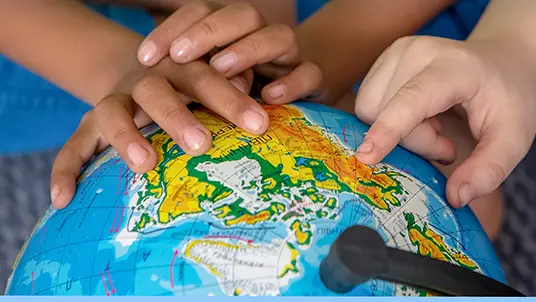
Geography deals with people, places, and the environment, and their mutual influences. The geographical strand covers topics such as continents, landforms, climate, and human geography. It includes how population, migration, and resource allocation influence people. Geography enables students to realize that places have a great impact on people’s lives. It is helpful to start with students’ local geography to build a basic understanding through concrete experience.
Civics and Government
The strand of civics and government studies how societies arrange power, decision-making, and conflict resolution. Civics and government entail the study of the structure of government, citizenship rights and duties, and the processes citizens use to influence their governance, including voting, laws, and civic engagement. It is usually the strand that is closest to preparing students for active citizenship.
Economics
Economics is the study of the decision-making process for producing, distributing, and consuming resources. This topic involves issues such as scarcity, supply and demand, trade, and various economic systems. At the elementary level, the concept of economics provides learners with a basis for understanding by connecting to the decisions they face daily, such as school lunch or grocery stores, which can be a starting point.
Culture
Culture is a set of beliefs, customs, practices, arts, and ways of life. This theme involves asking students to examine the effect of culture on people, cultural change over time, and the interaction between cultures. This aspect of social studies makes it very personal for students, as it touches on their own traditions.
Explore K-12 Social Studies Resources
See how Discovery Education can support social studies.
When Are the 5 Strands of Social Studies Taught?
The five strands of social studies are present at all levels of education, but they increase in sophistication and difficulty as students grow older. At early elementary levels, these strands are found in more simplified forms, such as learning about cultural practices within families and communities (Culture), mapping the classroom or neighborhood area (Geography), or learning about classroom rules (Civics). By upper elementary and middle school, the strands become more explicit and rigorous. Students study specific historical periods, analyze economic systems, examine geographic regions, and explore how governments are structured. High school typically separates the strands into distinct courses — U.S. History, World Geography, Government, Economics — while still drawing connections across them, since real historical and civic questions rarely fit into just one strand.
Why Are the 5 Strands of Social Studies Important?
The 5 strands of social studies matter because they reflect how societies actually work — as an interconnected web of history, place, power, resources, and shared identity, not as five separate subjects. A single historical event touches all five strands at once: a geographic setting, an economic context, governing decisions, cultural forces, and a lasting historical legacy. Teaching the strands separately gives students vocabulary and tools; teaching them in connection with one another is what builds genuine understanding.
The model also supports curricular planning that differentiates instruction and aligns with standards. It allows teachers to integrate several strands into a single unit or focus more on a particular strand when teaching a specific topic, as needed, while retaining the same format throughout the year. In this way, students develop cumulative knowledge instead of being exposed to disconnected social studies units.
For teachers looking for standards-aligned resources built around this framework, Discovery Education’s social studies curriculum offers content that helps students explore history, geography, civics, economics, and culture in an integrated, engaging way. Understanding the 5 strands of social studies gives both teachers and students a clear lens for approaching an enormous subject — one flexible enough to organize a single lesson or an entire curriculum, while still capturing the full, interconnected complexity of how societies actually work.